Accession No
1224
Brief Description
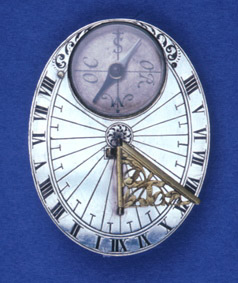
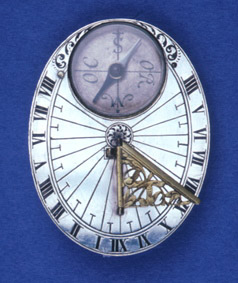
pocket horizontal dial, by Salomon Chesnon, French, 1670
Origin
France; Blois
Maker
Chesnon, Salomon
Class
dials
Earliest Date
1670
Latest Date
1670
Inscription Date
Material
metal (brass, silver, gilt metal); glass; hide (shagreen leather)
Dimensions
47 x 36 mm; d (compass) 19 mm
Special Collection
Provenance
Donated by Robert S. Whipple in 1953.
Inscription
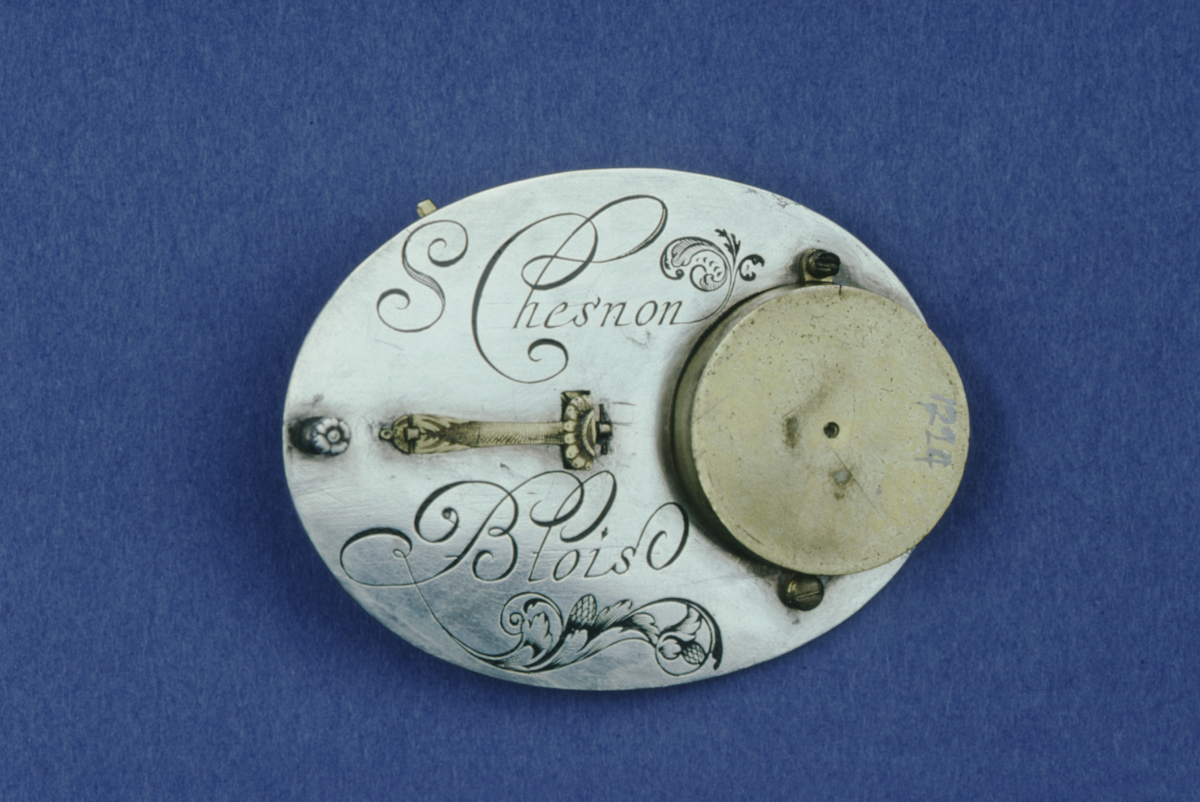
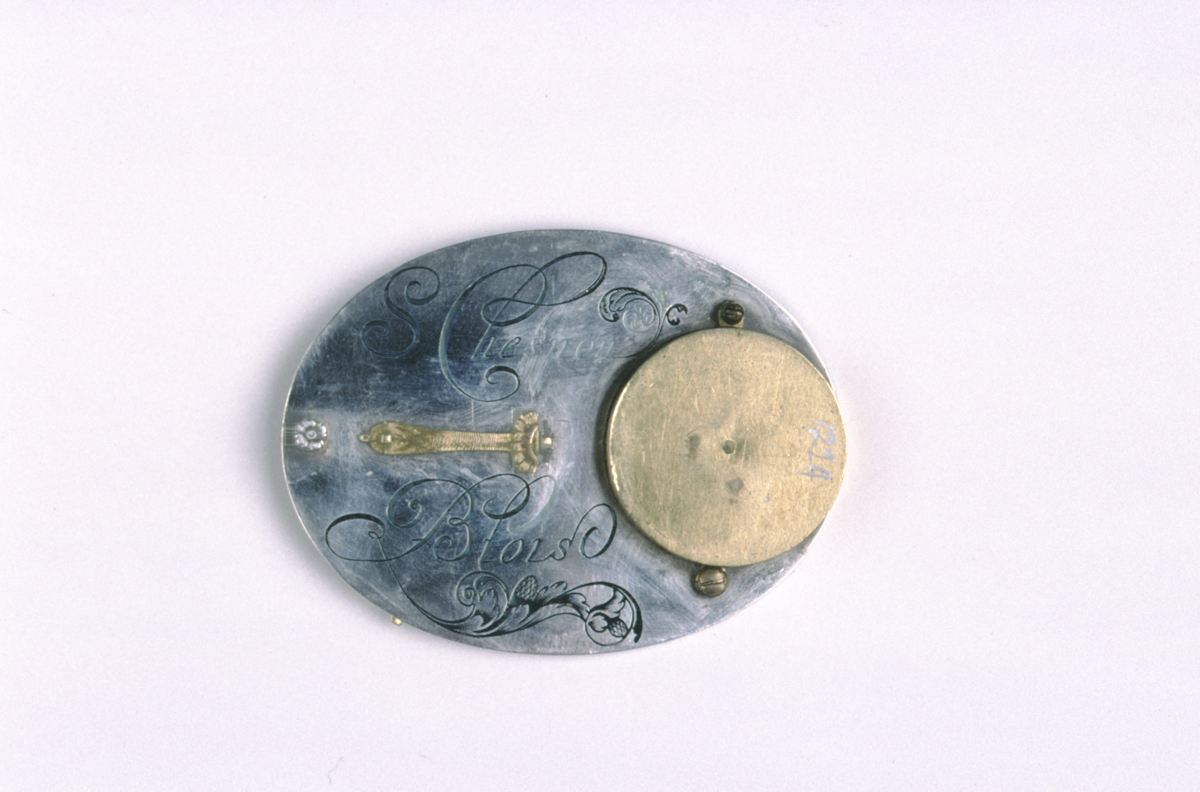
‘S. Chesnon
Blois’
Description Notes
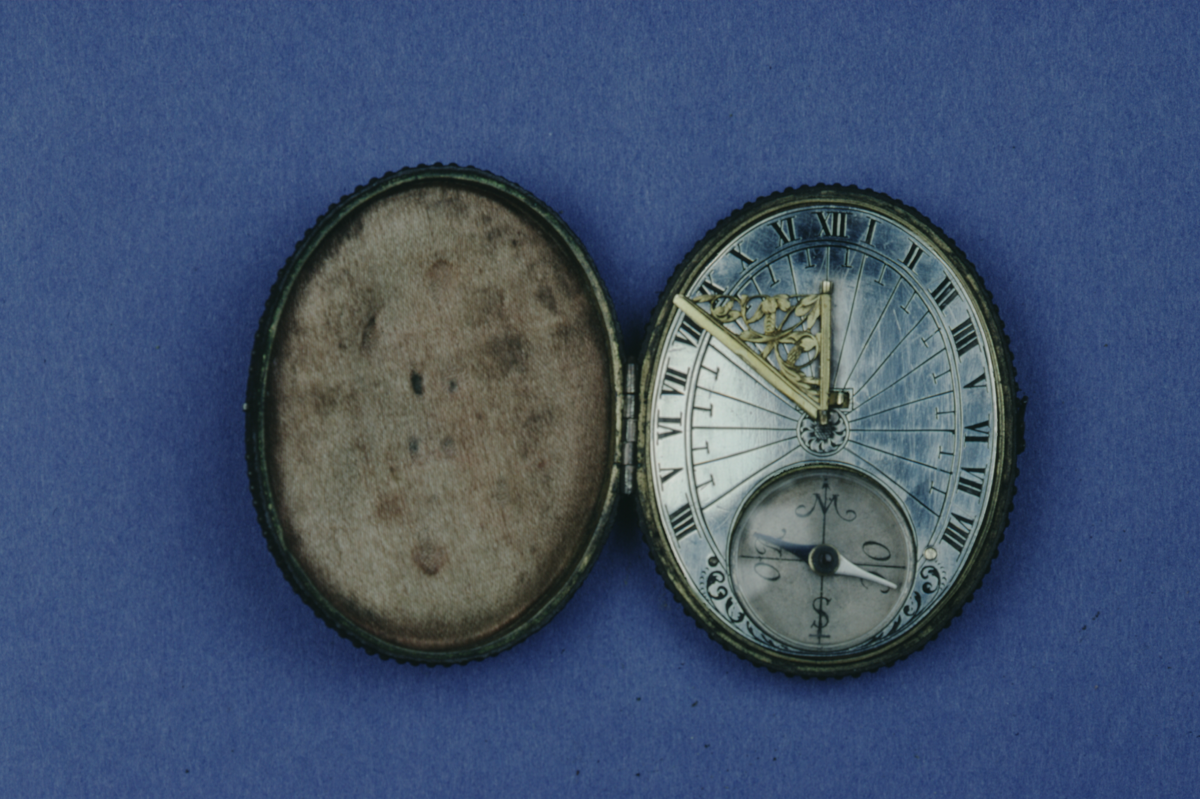
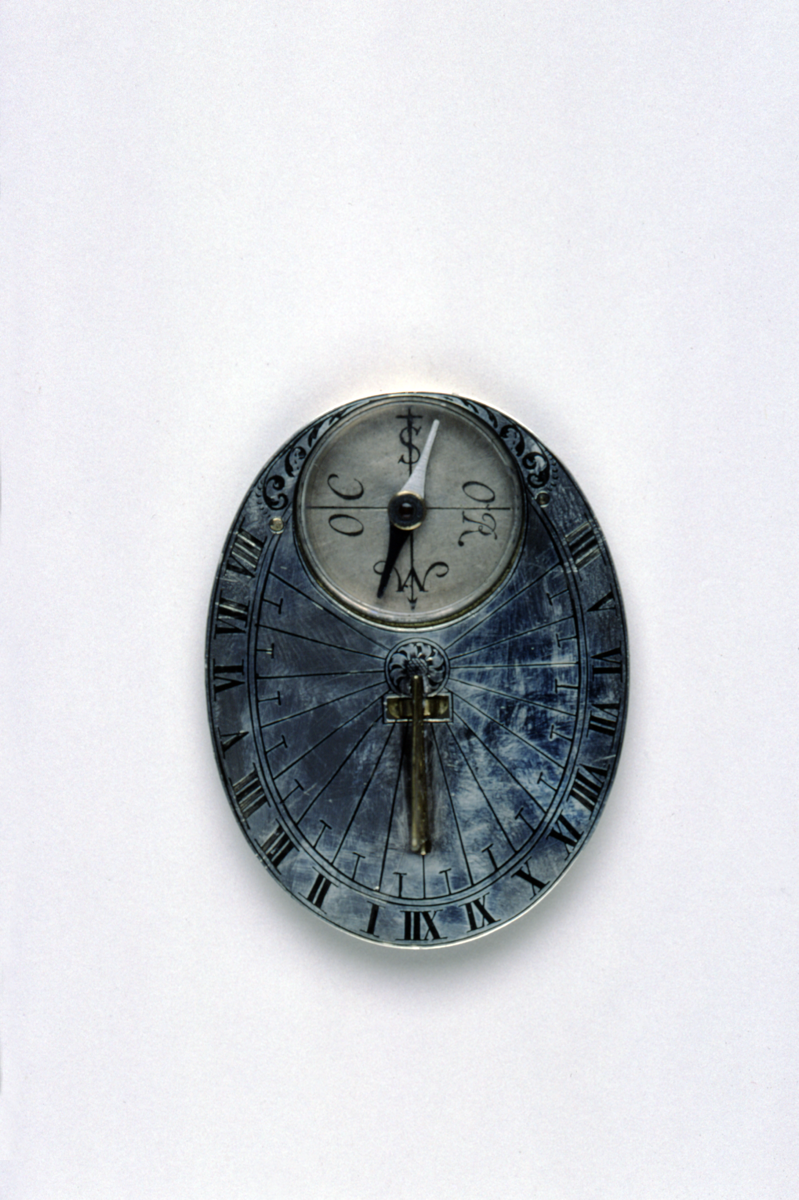
Oval silver dial plate, with hour circle divided IIII - XII, I - VIII, numbered by I, subdivided to 30 minutes. Pierced and decorated gilt gnomon for 51˚ 30´N. Dial plate set on gilt metal compass box and single turned foot. Inset compass with 4 cardinal points marked: ‘M, OC, S, OR’.
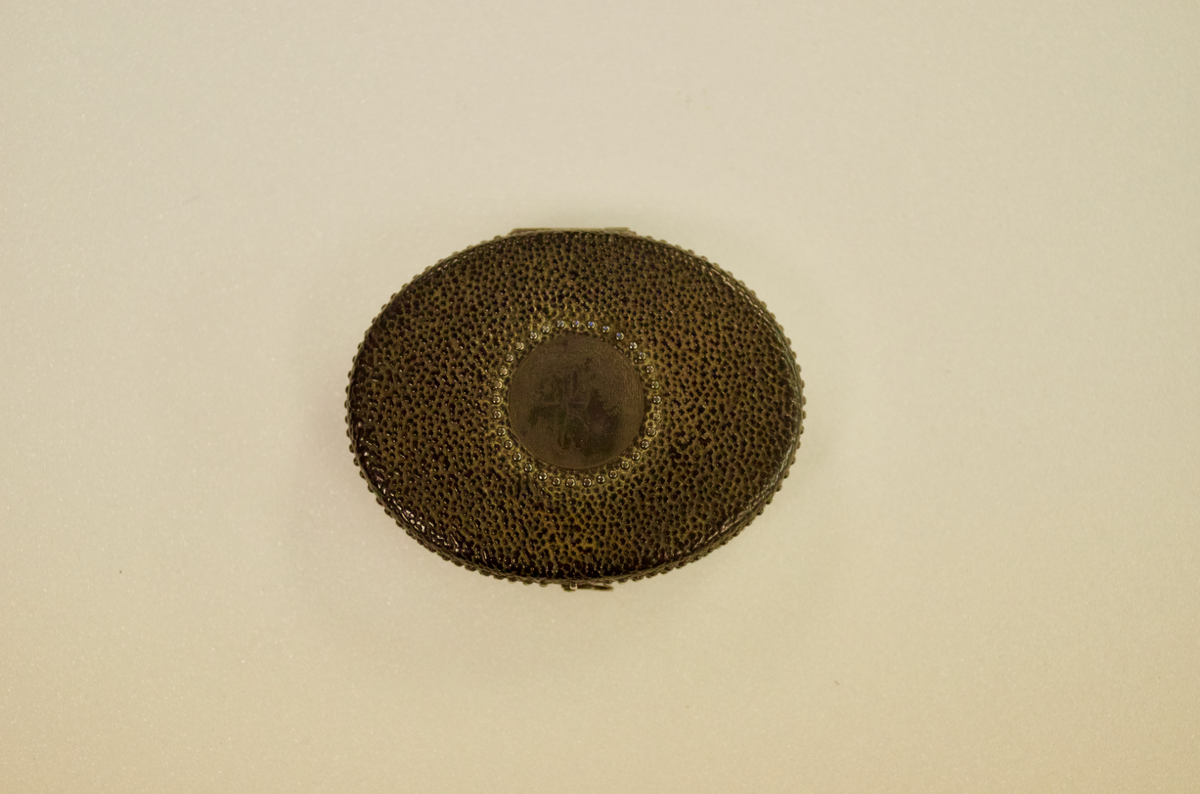
In brass case covered in black shagreen leather with silver piqué borders and engraved silver vignettes let in, showing rural scenes. [Compass needle is a modern replacement]
good/fair condition
References
Events
Description
In November 1944, R.S. Whipple’s donation to the University of Cambridge was put on show in the East Rooms of the Old Schools. The University accepted the donation on the condition that they found a new institution within which to house the collection.
Whipple himself wrote a guidebook to this exhibition, describing some of the more important objects and books on show. The front cover includes the following declaration: “The Exhibits are drawn from the Collection which Mr R.S. Whipple is presenting to the University and will form a nucleus for a History of Science Museum and Library in Cambridge.”
Whipple's label for this dial (along with Wh.0081, 0190, 0782 and 0956) was:
"Several dials of German manufacture are exhibited: some of these are richly decorated. The German makers (more particularly at Augsburg) appear to have made large numbers of inexpensive universal dials in different sizes. The French makers, in addition to making various kinds of universal dials, appear to have concentrated on one model, generally known as the "Butterfield" type. In this instrument the position of the gnomon is indicated by a bird's beak."
17/10/2025
Created by: Hannah Price on 17/10/2025
Description
The horizontal dial is the most common form of sundial. The portable version proved very popular with the upper classes during the 19th Century. During this period it could best be described as the wristwatch of its day.
The hour lines are engraved onto a horizontal surface, with a gnomon (pointer) in the centre. Seasonal variations (caused by Earth’s orbit being elliptical, not circular) have to be compensated for, as they can affect the raw reading by up to 18 minutes.
18/10/2002
Created by: Saffron Clackson and Boris Jardine on 18/10/2002
FM:39826
Images (Click to view full size):