Accession No
0328
Brief Description
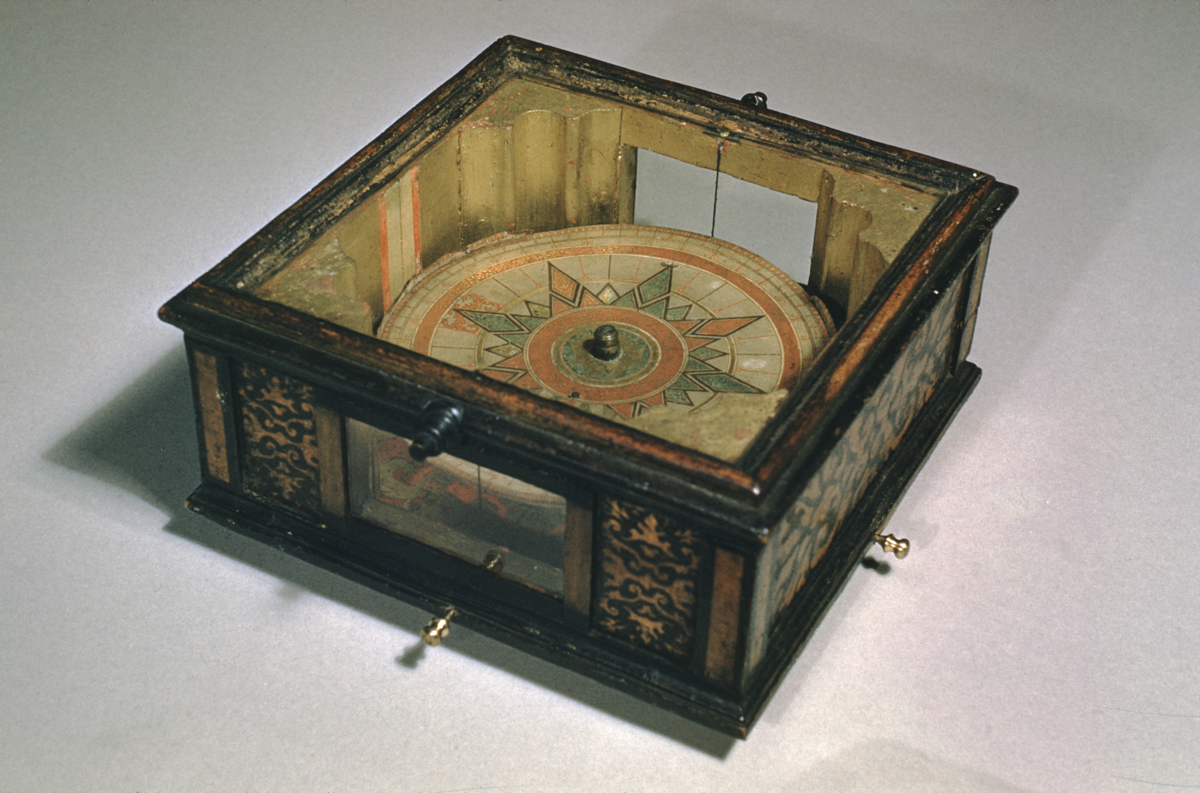
mariner’s azimuth compass, by Joseph da Costa Miranda, Portuguese, 1711
Origin
Portugal; Lisbon
Maker
Miranda, Joseph da Costa
Class
magnetism; navigation
Earliest Date
1711
Latest Date
1711
Inscription Date
1711
Material
wood; glass; metal (brass); paper
Dimensions
length 263mm; width 237mm; height 123mm
Special Collection
Robert Whipple collection
Provenance
Purchased from A. Fleming, Ltd in 09/1928.
Inscription
‘Joseph da Costa
Miranda afez em
Lisbon Anno 1711’ (reverse of card)
Description Notes
Mariner’s azimuth compass, by Joseph da Costa Miranda, Portuguese, 1711.
Wooden-cased amplitude magnetic compass. Square wooden case, inlaid, glazed on top and partially on two sides. Interior painted gold and red. 2 wooden studs for gimbals. four brass pins. Two fiducial threads in glazed sides. Separate wooden base, decorated in red and gold on top, central brass point for compass card. Decorated compass card. 32 point inner rose; outer scale divided 0 - 90 - 0 - 90 - 0, numbered by 10˚, subdivided to 1˚. Raised edges to E and W each graduated 45 - 0 - 45, divided to 1˚. Reverse has single bar magnet held by central brass nut. Also a pin to the North, and the ends are held in place. Card wooden with printed paper rose.
References
Events
Description
Between 1913 and 1952, R.S. Whipple collected 1,122 historic scientific instruments. During this time Whipple became a connoisseur, developing a keen eye for fine and rare artefacts. This is one of the standout treasures he acquired over four decades of collecting.
This beautiful instrument was designed to measure "magnetic variation", the difference between magnetic north and true geographic north. As this varies over the surface of the globe, mariners had to measure it on the go.
The sighting wires in the two side windows were used to take the bearing of the sun at sunrise and sunset. By comparing this observation with printed tables, variation could be calculated and the reading of the main steering compass corrected accordingly.
07/10/2025
Created by: Hannah Price on 07/10/2025
Description
Magnetic compass
The magnetic compass consists of a magnetic needle attached to a compass card, graduated into angular points, and is used for navigation. The first known dry pivoted compass is dated as early as 1269.
A simple bar magnet is fixed beneath the compass card, its north-seeking end fastened under the elaborate fleur-de-lis on the card. As the ship changes course, the card swings, keeping the fleur-de-lis pointing to magnetic north.
The magnetic north pole is located at some distance from the geographic pole, around which the Earth rotates. This location drifts slowly over the centuries and at present lies in the Queen Elizabeth Islands, off northern Canada, between 100° and 110° W.
04/08/2008
Created by: Dr Anita McConnell on 04/08/2008
FM:39877
Images (Click to view full size):