Accession No
0023
Brief Description
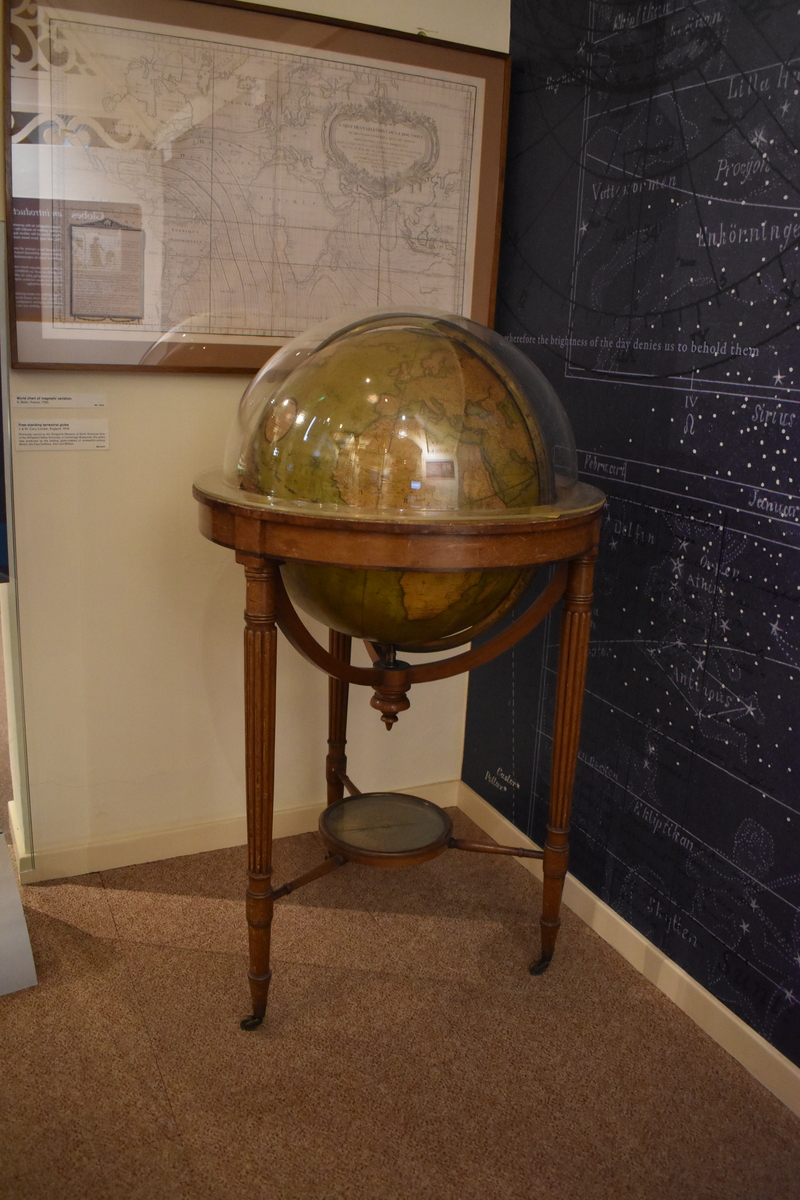
21-inch terrestrial globe, by J. and W. Cary, English, 1818 impression of 1815 edition
Origin
England; London; Strand
Maker
J. and W. Cary
Class
cartography
Earliest Date
1818
Latest Date
1818
Inscription Date
1818
Material
paper; wood; metal (brass, steel); glass
Dimensions
d 530 mm; Horizon circle d 649 mm
Special Collection
Provenance
Inscription
‘CARY’S
NEW
TERRESTRIAL GLOBE
EXHIBITING
The Tracks and Discoveries made by
CAPTAIN COOK;
Also those of CAPTAIN VANCOUVER on the
NORTH WEST COAST OF AMERICA;
And M. DE. LA PEROUSE, on the coast of TARTARY.
TOGETHER
With every other Improvement collected from
Various Navigators to the present time.
LONDON
Made & Sold by J & W Cary Strand March 1st 1815’ (cartouche)
‘WITH ADDITIONS AND CORRECTIONS TO 1818’ (below cartouche)
Description Notes
21-inch terrestrial globe, by J. & W. Cary, London, 1818 impression of 1815 edition. Plaster sphere with paper gores.
18 engraved and hand coloured gores. Polar axis, brass hour circle divided I - XII, I - XII, numbered by I, subdivided to minutes. Brass meridian circle divided 90˚ - 0 - 90˚ - 0 - 90˚, numbered by 10˚, subdivided to 15´. Wooden horizon circle with 4 piece printed calendar plate. Meridian circle clamp. Set in tripod cradle with fluted wooden legs on castors. Compass below globe suspended between legs: 32-point rose divided 0 - 90˚ - 0 - 90˚ - 0 and 0 - 360˚, numbered by 10˚, subdivided to 1˚. Blued steel needle; glazed cover.
Condition fair; complete.
References
Events
Description
Terrestrial globes modelled the Earth’s movements in relation to the stars, Sun and Moon, and promoted interest in exploration and charting the surface of the globe. Having been used as aids for sea merchants since the twelfth century, the role of maps in navigation practices had been well established by the seventeenth century; however, by the end of early modern period the use of globes as navigational tools diminished. In the nineteenth century, the role of the globe turned from astronomical to geographical study as the importance of the Earth’s surface was increasingly emphasized. During this period, terrestrial globes were used increasingly as teaching aids for geography lessons. This example was previously owned by the Sedgwick Museum at the University of Cambridge, and was likely used in teaching demonstrations. The globe was produced by the instrument maker and map publisher John Cary (1755–1835) and his brother William Cary (1759–1825); the Cary firm became the leading globe-making producer in nineteenth-century Britain. In 1770, John began his apprenticeship to William Palmer of New Street Square London, and became a freeman in 1778. Three years later, John opened his globe-making business and convinced William to join him in the production of globes and planetaria; however, the two brothers maintained separate businesses with other projects.
14/01/2014
Created by: Allison Ksiazkiewicz on 14/01/2014
FM:39912
Images (Click to view full size):