Accession No
0472
Brief Description
dipleidoscope meridian instrument, by Edward John Dent, English, 1845 (c)
Origin
England; London
Maker
Dent, Edward John
Class
dials
Earliest Date
1843
Latest Date
1853
Inscription Date
Material
metal (brass, oxidised brass, silver, steel); glass; liquid
Dimensions
length 129mm; breadth 120mm; height 115mm
Special Collection
Robert Whipple collection
Provenance
Purchased from T.H. Court in 03/1929.
Inscription
‘E J DENT
LONDON
PATENT.
1660.’
Description Notes
Dipleidoscope meridian instrument, by E.J. Dent, English, c. 1845.
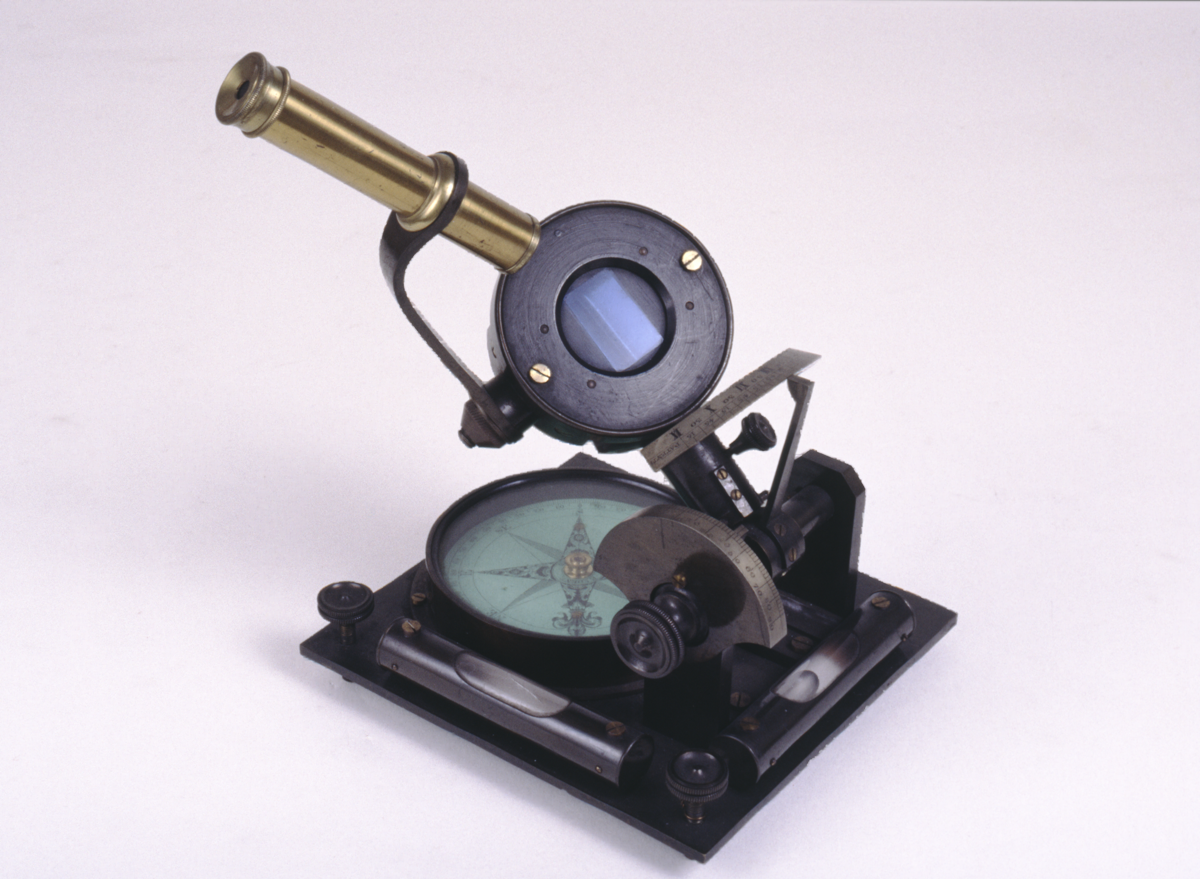
Oxidised brass square base set on 2 levelling screws and a third fixed foot; 2 bubble levels mounted on the base. Compass box with a green compass card mounted on the needle; 8-point rose; degree scale divided 0 -90˚ - 0 - 90˚ - 0, numbered by 10˚, subdivided to 1˚. Pair of uprights to silvered latitude arc divided 0 - 90˚, numbered by 10˚, subdivided to 1˚. Silvered hour arc divided IX - XII, I - III, numbered by I, subdivided to 15 minutes, with index. Telescope with draw tube focussing on the mirrors.
Fair condition, one of the spirit levels is cracked
References
Events
Description
In November 1944, R.S. Whipple’s donation to the University of Cambridge was put on show in the East Rooms of the Old Schools. The University accepted the donation on the condition that they found a new institution within which to house the collection.
Whipple himself wrote a guidebook to this exhibition, describing some of the more important objects and books on show. The front cover includes the following declaration: “The Exhibits are drawn from the Collection which Mr R.S. Whipple is presenting to the University and will form a nucleus for a History of Science Museum and Library in Cambridge.”
Whipple's own explanatory text for this object was:
"Dipleidoscope. The Dipleidoscope is a simple form of transit instrument designed by J.M. Bloxam about 1875. Several different models were made by E.D. Dent and Co. and the instrument is generally referred to as the Dent Dipleidoscope."
17/10/2025
Created by: Hannah Price on 17/10/2025
Description
This instrument is used to determine true noon to an accuracy of within 10 seconds. A prism creates a double image of the sun, which merge together as the sun approaches its high point in the sky. When the two images overlap, it is local true noon.
The chronometer and clockmaker Edward John Dent patented his design for the dipleidoscope in 1843, and he exhibited the instrument at the Great Exhibition in London in 1851.
Knowing local noon is useful, for example, for checking and correcting clocks. It is also used in the determination of longitude, which can be calculated by finding the difference in time between local noon and midday at the prime meridian in Greenwich. Whilst the former can be found using a dipleidoscope or sextant, the latter must be read from an accurate chronometer set to Greenwich time.
16/07/2015
Created by: Joshua Nall on 16/07/2015
FM:39955
Images (Click to view full size):