Accession No
0676
Brief Description
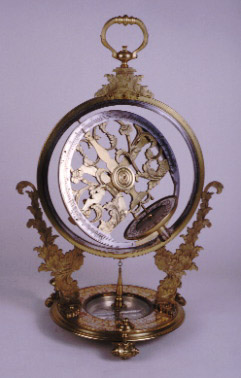
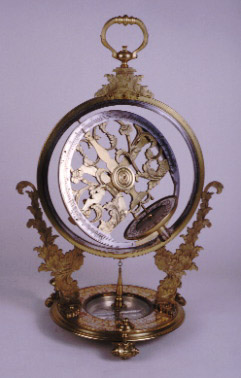
mechanical universal equinoctial ring dial, by John Rowley, English, 1715 (c)
Origin
England; London
Maker
Rowley, John
Class
dials
Earliest Date
1715
Latest Date
1715
Inscription Date
Material
metal (brass, silver, steel); glass
Dimensions
height 400mm; breadth 295mm; depth 220mm
Special Collection
Robert Whipple collection
Provenance
Purchased by Robert Stewart Whipple from Antique Art Galleries, London, England, in 06/1931.
Inscription
‘Faite par J. ROWLEY Maistre de Mechanique du Roy’ (meridian ring reverse)
Description Notes
Set on 3 scroll feet, decorated with acanthus leaves with screw levelling feet. Base plate with inset silvered compass; 8-point rose; fleur-de-lys for N; degree scale divided 0 - 90˚ - 0 - 90˚ - 0, numbered by 10˚, subdivided to 1˚; steel needle. Silvered scale on base plate with an equation of time table ‘LA: PENDULE: ADVANCE: LA: PEN: RETARD’ twice with an associated calendar (months marked in French, numbered by 10 days, subdivided to 1 day); also marked ‘Equations de Jours Naturels’. Plumb bob suspended from the fixed outer ring over the compass.
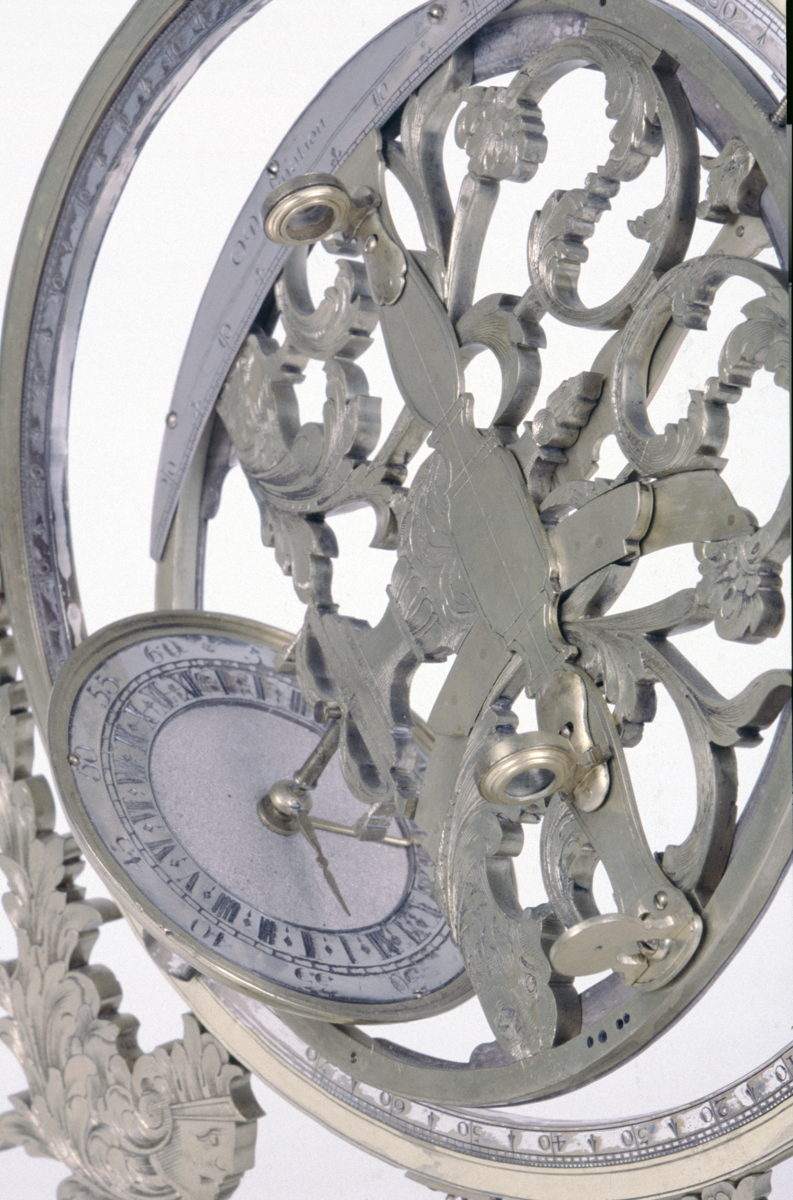
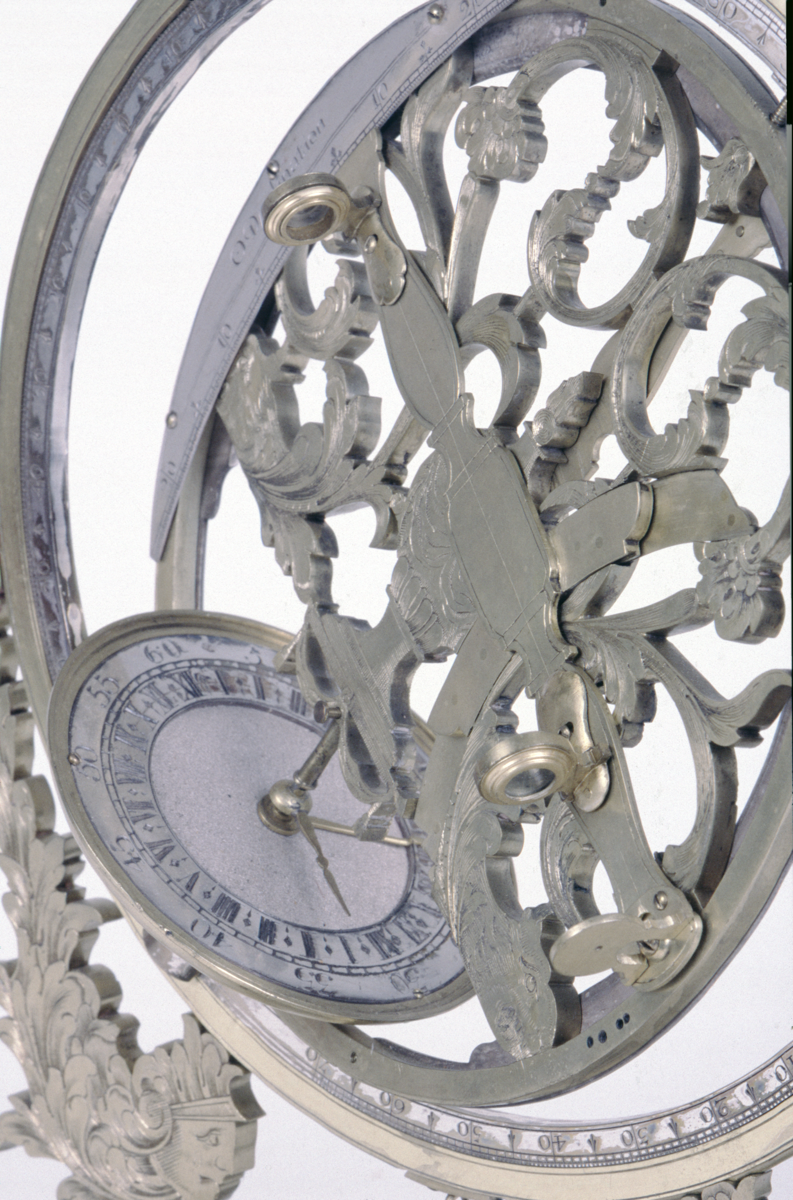
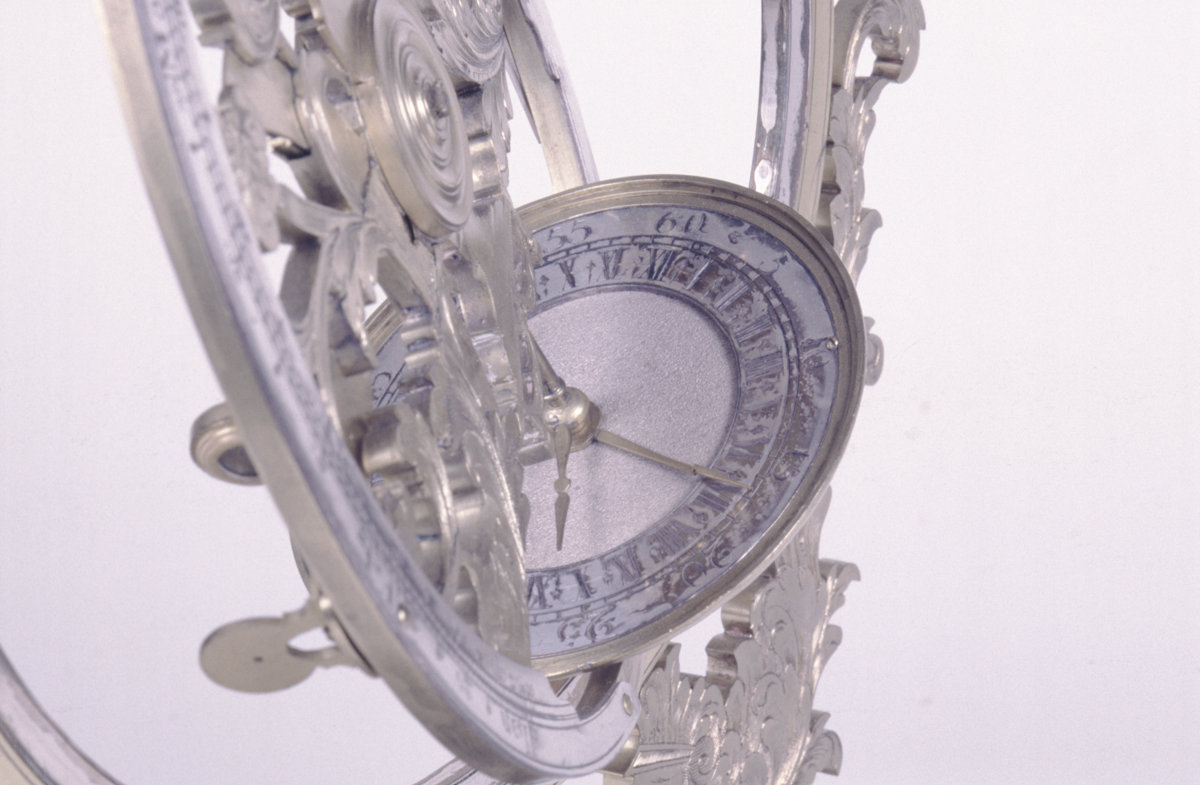
Fixed outer circle supported on two decorative supports, engraved with leaves and heads. Meridian ring turned manually within the outer ring; silvered and divided 70˚ - 0 - 90˚ - 0 - 70˚, numbered by 10˚, subdivided to 1˚; ‘suspension’ shackle with handle and decorative engraving of leaves and griffin’s heads. Equinoctial ringwith decorative fretwork; date scale around rim divided to named month, numbered by 10 days, subdivided to 1 day; on the reverse a declination arc divided 23˚ 30´ - 0 - 23˚ 30´, numbered by 10˚, subdivided to 15´. At 90˚ to the equinoctial ring and set within its base is an hour circle with silvered scale divided I - XII, I - XII, numbered by I, subdivided to 30 minutes and [0] - 60, numbered by 5 minutes, subdivided to 1 minute; 2 clockwork driven hands. Pair of sights across the equinoctial ring with pinhole and lens.
References
Events
Description
Between 1913 and 1952, R.S. Whipple collected 1,122 historic scientific instruments. During this time Whipple became a connoisseur, developing a keen eye for fine and rare artefacts. This is one of the standout treasures he acquired over four decades of collecting.
This elaborate dial was one of R.S. Whipple's most expensive purchases. A mechanical model of the heavens, it can be used to tell the time at any latitude. Its maker, John Rowley, was recognised as one of the finest instrument-makers of his day, working from 1715 as master of mechanics to George I.
07/10/2025
Created by: Hannah Price on 07/10/2025
Description
The universal equinoctial ring dial was designed by the English mathematician William Oughtred in the first half of the seventeenth century. It could be used at any latitude, so was a popular timekeeper for sailors and other travellers. It was really a much simplified version of the armillary sphere, only keeping the parts which were needed for telling the time.
The universal equinoctial ring dial consists of two rings and a bridging bar inside the inner ring. The outer ring represents a circle passing through the North and South celestial poles. The inner ring is called the ‘equinoctial’ ring because it represents the celestial equator. The bridging bar represents the axis of the world, just as the gnomon on an ordinary horizontal dial does. So the instrument is a very simple model of the heavens.
01/02/2001
Created by: Dr Hester Higton on 01/02/2001
FM:39966
Images (Click to view full size):