Accession No
0316
Brief Description
astronomical compendium, French, first half 17th century
Origin
France
Maker
Class
dials
Earliest Date
1600
Latest Date
1650
Inscription Date
Material
metal (brass); wood; glass; rope (string)
Dimensions
length 86mm; breadth 92mm; thickness 29mm
Special Collection
Robert Whipple collection
Provenance
Purchased from Gertrude Hamilton (trading as ’Mercator’), Paris, France, in 08/1928.
Inscription
‘Lat 48˚ 50’’ (on side of leaf II).
Description Notes
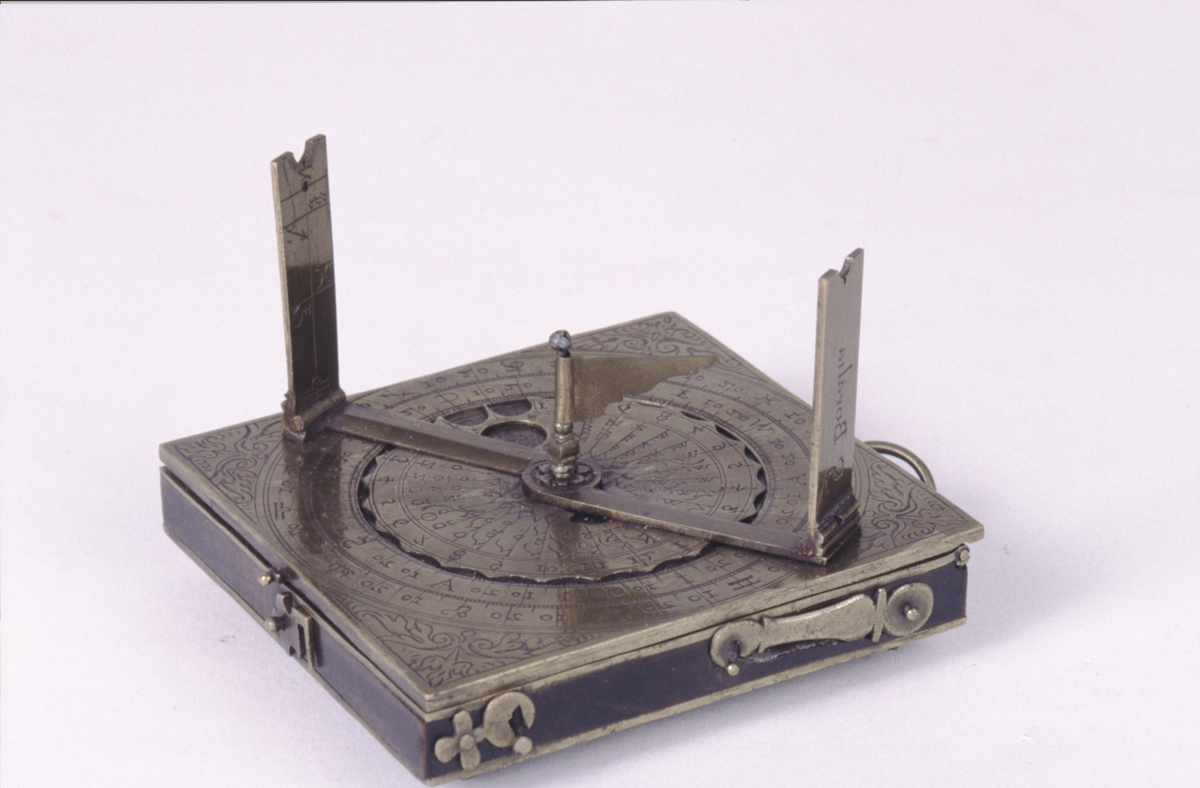
Wooden core covered with brass plates; suspension shackle; compartments for wind vane (and for something else; 17-1-2000) in leaf II.
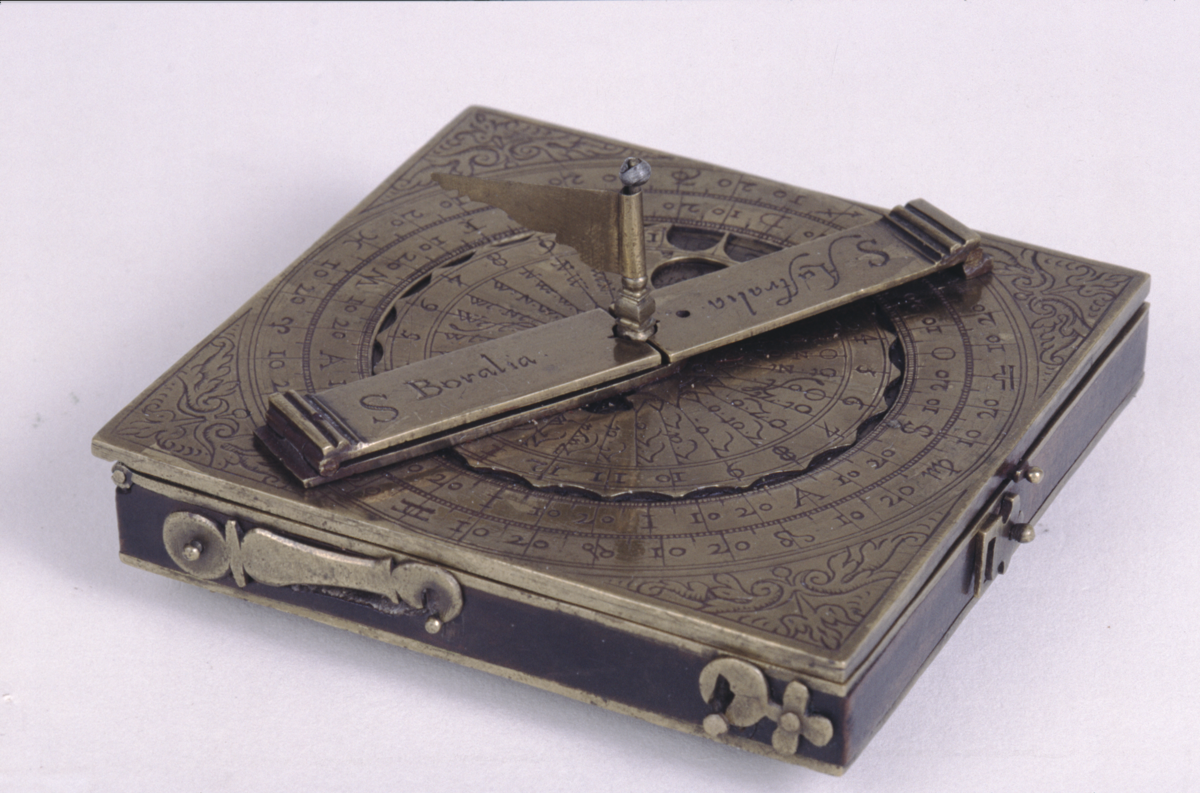
Leaf Ia: zodiac scale marked by sign, numbered by 10˚, subdivided to 1˚. (Also a scale marked by initialled month, numbered by 10, divided to 1; 17-1-2000). Toothed volvelle disc divided 1 - 12, 1 - 12, numbered by 1; index over; lunar age scale divided 1 - 29 1/2, numbered by 1. Window to show N point of compass. Lunar phase diagram, window and index, divided 1 - 12, 1 - 12, numbered by 1 for nocturnal. Volvelle also marked with points of the compass. alidade with folding pinhole sights, marked ‘S. Australia’ & ‘S. Boralia’ with zodiac symbols. Decorative engraving in corners. Wind vane screws into the centre of this leaf.
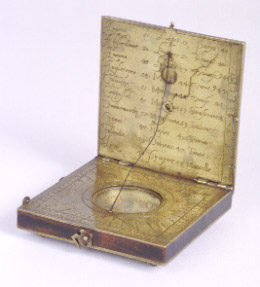
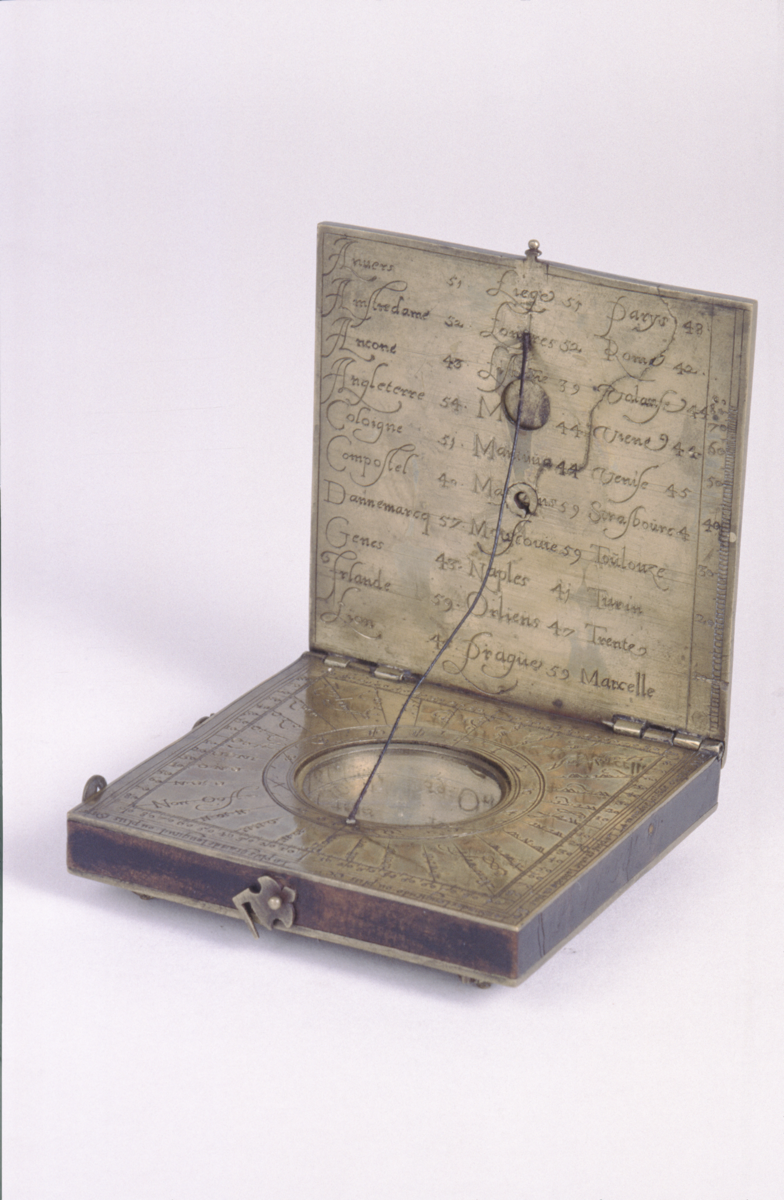
Leaf Ib: scale of latitudes divided 0 - 90˚, numbered by 10˚. List of towns and latitudes.
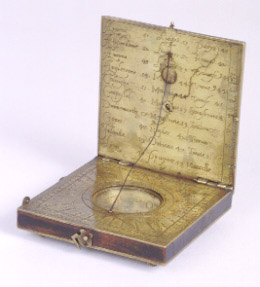
Leaf IIa: horizontal string gnomon dial divided 4 - 12, 1 - 8, numbered by 1, subdivided to 30 minutes. Edge of plate is calibrated as a geometric square divided [0] - 90 - [0], numbered by 10, subdivided to 1; marked ‘La moindre latitude ou plue mer’ etc. (see history file). 32-point wind rose. Inset compass with cardinal points marked. Marked ‘Lat 48˚ 50’.
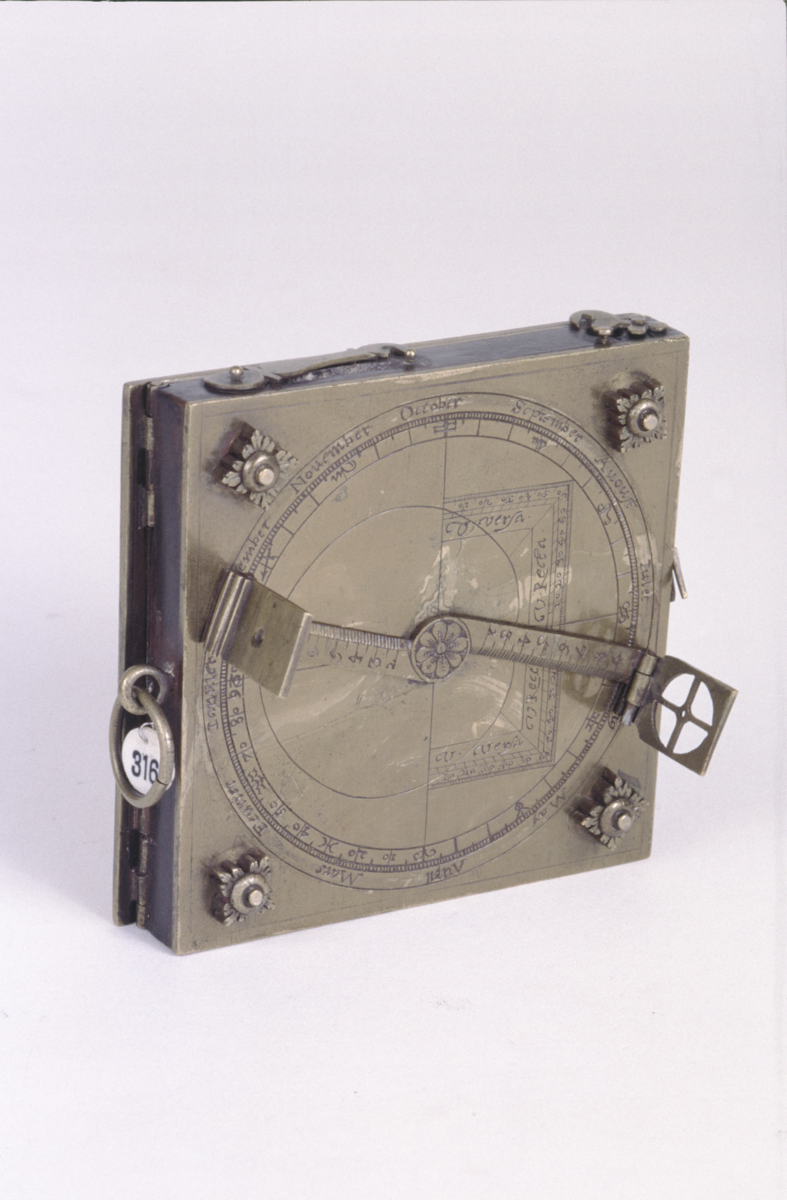
Leaf IIb: four feet. Degree scale divided [0] - [360˚], marked by month and zodiac sign; one quadrant numbered by 10˚. Geometric square divided [0] - 60 - [0], numbered by 10, subdivided to 1, marked ‘V. Versa’ and ‘V. Recta’.
Alidade divided 2 - 9, numbered by 1, with folding pinhole and windward pinhole sights.
Condition: good.
References
Events
Description
An astronomical compendium is an instrument that carries numerous devices for telling the time and performing astronomical calculations. Many compendia were made in the German lands in the late 16th and early 17th centuries. They are often beautifully engraved in gilt brass. Typically such compendia carry a sundial, various lunar and solar volvelles, a compass, tables of latitude, and a perpetual calendar.
Two characteristics are typical of the construction of these instruments: first, they were often made as lavishly as possible; second, they are ingeniously constructed, with as many instruments as possible filling the available space. Each plate of the compendium is known as a 'leaf', and carries a different device. Most of the instruments on a compendium are used to simplify astronomical calculations. Many compendia have volvelles—rotating discs that show the phases of the Moon, the positions of planets, and other such phenomena.
Almost all compendia have at least one form of sundial. These are often adjustable for use in different places, and are accompanied by lists of the latitudes of major cities around the world. Sometimes these lists are obviously functional, including various towns and major ports, but often they are more fanciful, including places such as Babylon, Alexandria, Moscow, Cuba, Constantinople, and Nineveh (an important ancient city in Assyria). Like the gilt decoration and detailed engraving, these were intended to show the wealth and status of the instrument's owner.
Some compendia also carry stereographic projections. These are multi-purpose maps of the heavens, allowing many astronomical calculations to be simplified. Using these, people could determine the time of sunrise and sunset, and the position of the Sun in its annual (apparent) motion through the sky.
19/12/2013
Created by: [Adapted from Boris Jardine’s 2008 Explore article] on 19/12/2013
FM:39978
Images (Click to view full size):