Accession No
0782
Brief Description
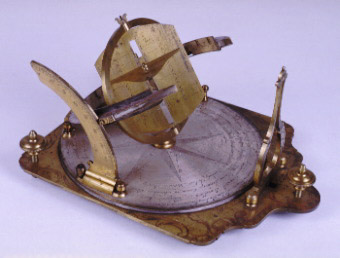
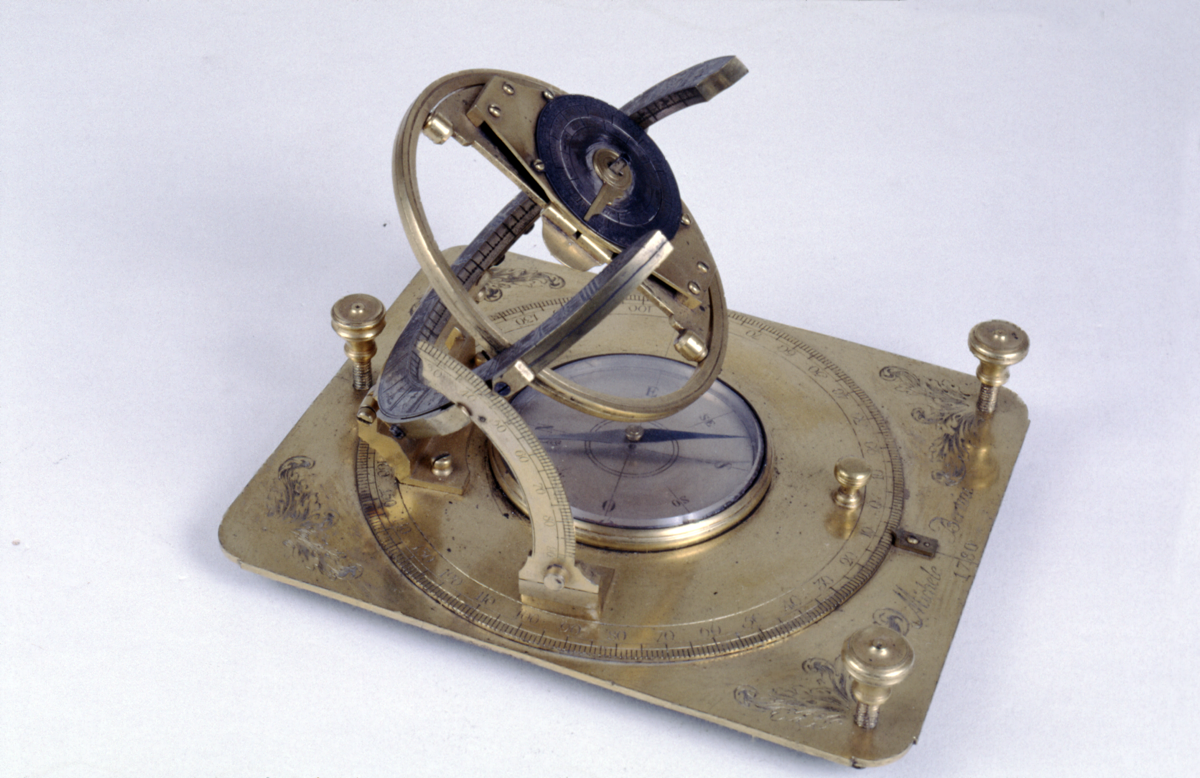
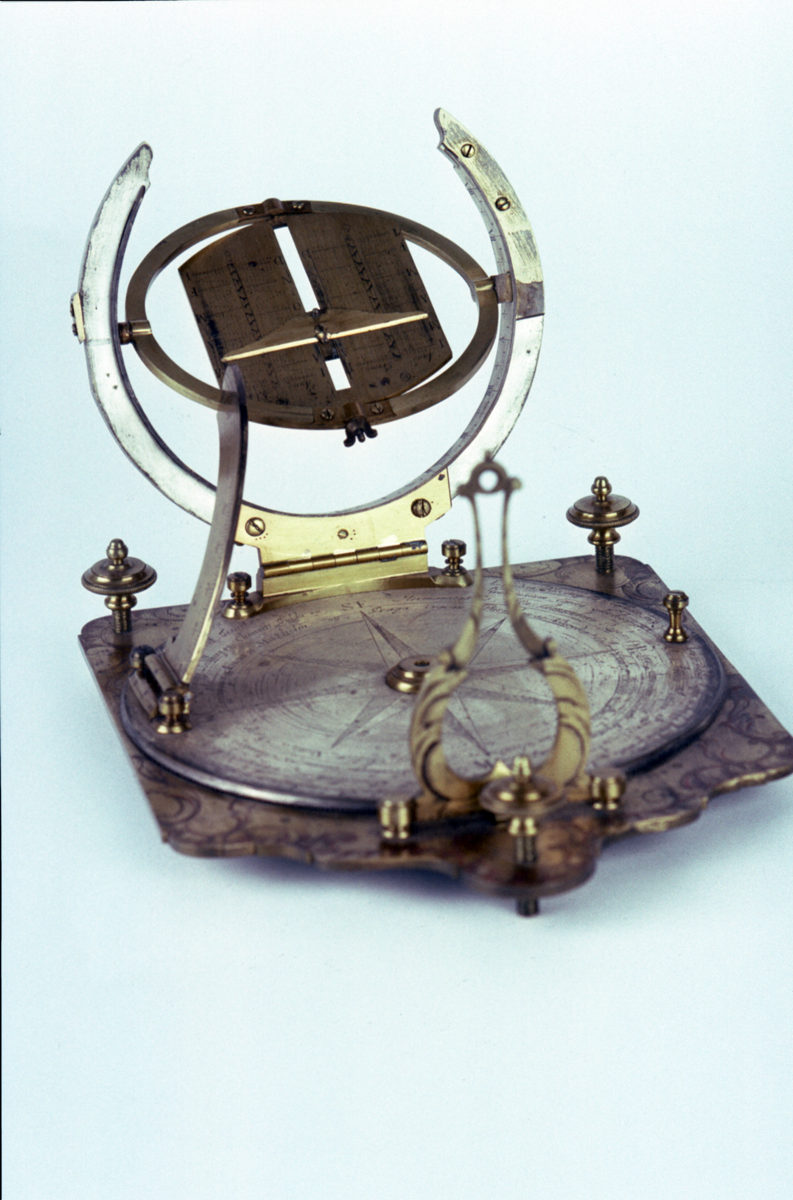
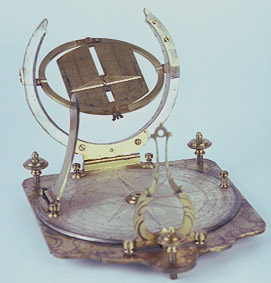
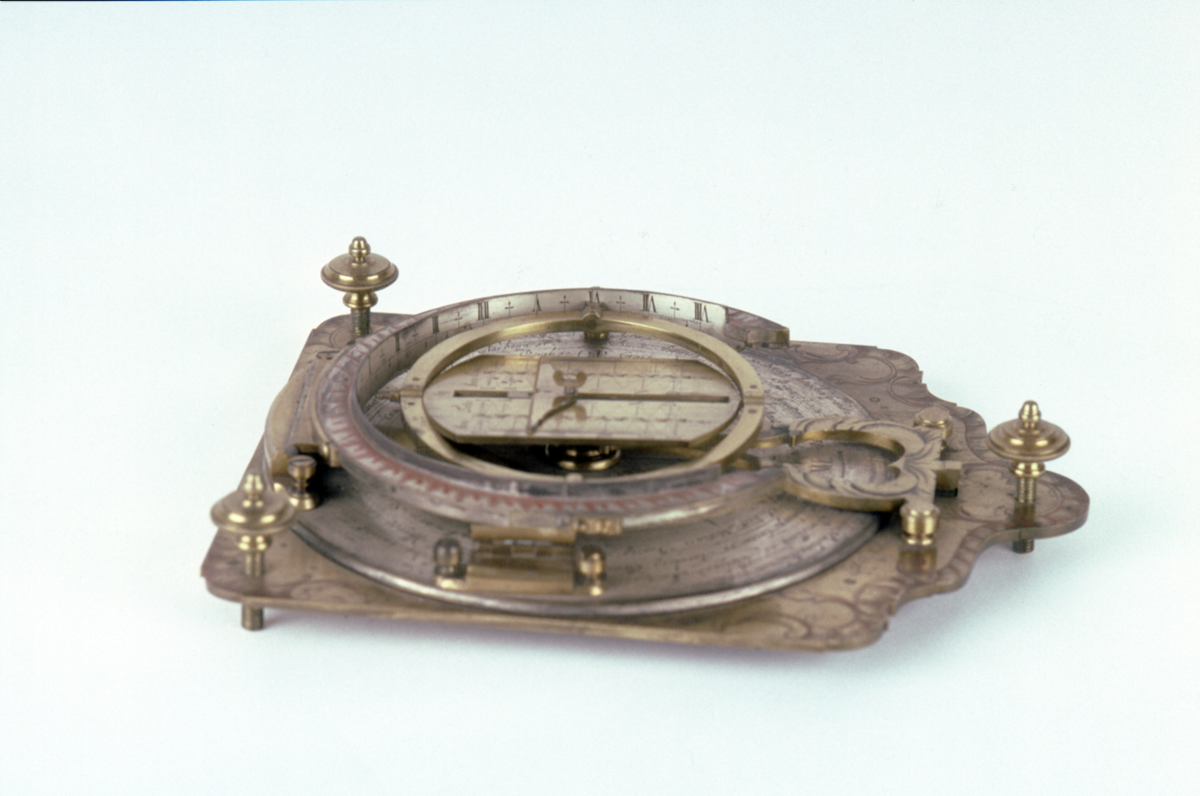
universal equinoctial dial, by J. B. Schmidt, Austrian, 1800 (c)
Origin
Austria; Vienna
Maker
Schmidt, J. B.
Class
dials
Earliest Date
1800
Latest Date
1800
Inscription Date
Material
metal (brass, silver); glass; wood; cloth (velvet); hide (leather)
Dimensions
length 217mm; breadth 169mm; height 45mm; box length 246mm; breadth 190mm; height 63mm
Special Collection
Robert Whipple collection
Provenance
Purchased by Robert Stewart Whipple from Antique Art Galleries, Grafton Street, London, England, on 05/05/1935.
Inscription
‘J.B. Schmidt in Wienn’ (base plate)
Description Notes
Universal equinoctial dial, by J. B. Schmidt, Austrian, c. 1800.
Decorated brass plate on 3 adjustable feet. Decorated gallows. Silvered wind rose which may be turned over the plate; 8-point rose with cardinal points marked in Latin. Hinged brass latitude arc divided [5˚] -90˚, numbered by 10˚, subdivided to 30´. Hinged hour circle segment with silvered inner face, decoration picked out in red; inner face divided IIII - XII, I - VIII, numbered by I, subdivided to 3 minutes. Within the hour circle a second, oval, ring supports a bridge plate with pinhole gnomon, calibrated by month, subdivided by modified transversals to 1 day, with 4 separate calibrations for ‘Anno Primo’, ‘Anno Secundo’, ‘Anno Tertio’ and ‘Anno Bisextili’. List of town and latitudes on the wind rose plate (see history file).
Wooden box lined with red velvet and covered with leather.
References
Events
Description
In November 1944, R.S. Whipple’s donation to the University of Cambridge was put on show in the East Rooms of the Old Schools. The University accepted the donation on the condition that they found a new institution within which to house the collection.
Whipple himself wrote a guidebook to this exhibition, describing some of the more important objects and books on show. The front cover includes the following declaration: “The Exhibits are drawn from the Collection which Mr R.S. Whipple is presenting to the University and will form a nucleus for a History of Science Museum and Library in Cambridge.”
Whipple's label for this dial (along with Wh.0081, 0190, 0956 and 1224) was:
"Several dials of German manufacture are exhibited: some of these are richly decorated. The German makers (more particularly at Augsburg) appear to have made large numbers of inexpensive universal dials in different sizes. The French makers, in addition to making various kinds of universal dials, appear to have concentrated on one model, generally known as the "Butterfield" type. In this instrument the position of the gnomon is indicated by a bird's beak."
17/10/2025
Created by: Hannah Price on 17/10/2025
FM:40015
Images (Click to view full size):