Accession No
1851
Brief Description
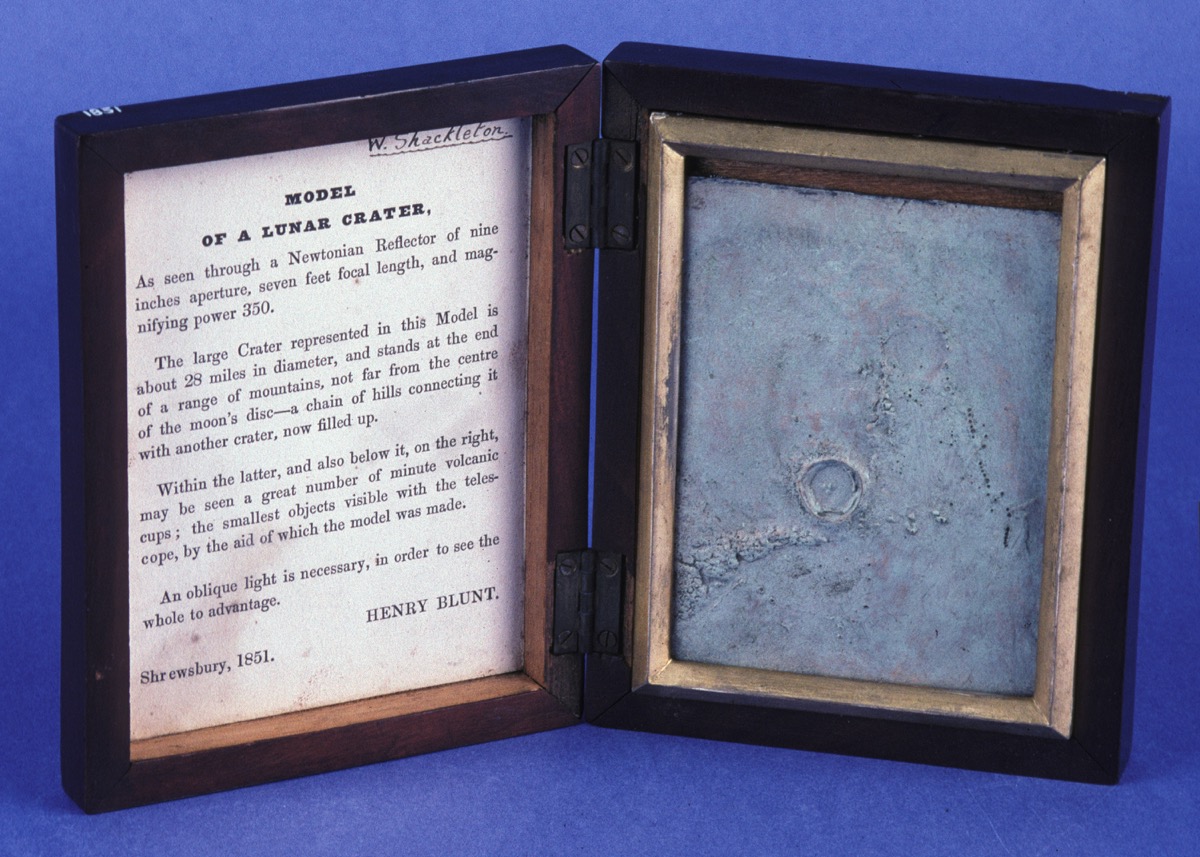
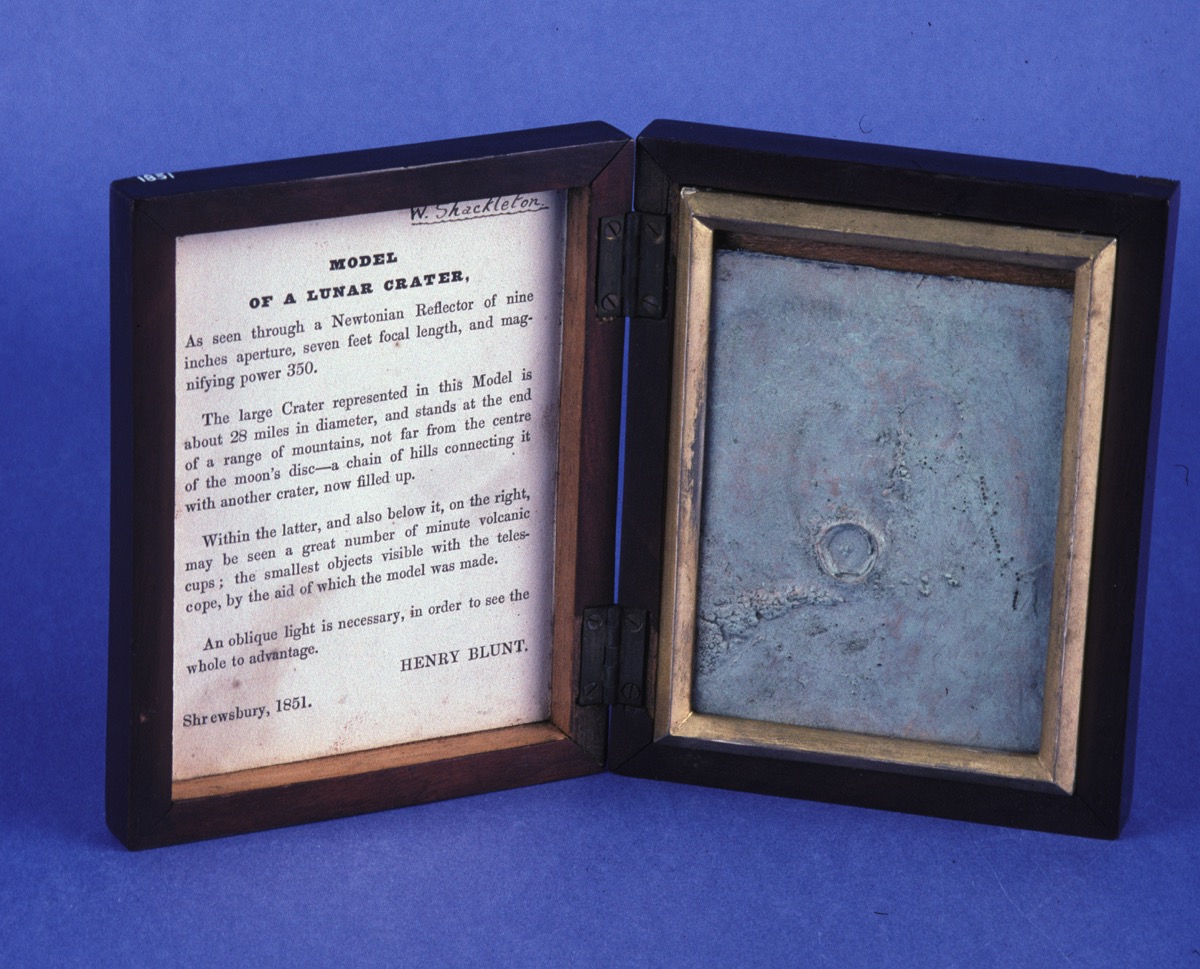
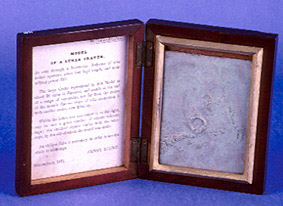
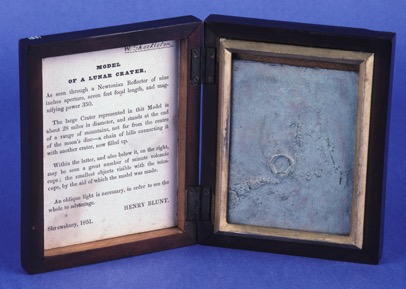
boxed electrotype copy of a plaster topographical (relief) model of the lunar (moon) crater Eratosthenes, with printed description, by Henry Blunt, English, 1851
Origin
England; Shrewsbury
Maker
Blunt, Henry
Class
astronomy; demonstration
Earliest Date
1851
Latest Date
1851
Inscription Date
1851
Material
wood; metal (copper; gilt metal [gold?]; brass); paper; paint
Dimensions
Special Collection
Heywood collection
Provenance
Purchased from the Professor Harold Heywood collection under estate duty exemption benefit with the assistance of a Science Museum PRISM grant-in-aid.
Inscription
see description notes
Description Notes
Boxed electrotype copy of a plaster topographical (relief) model of the lunar (moon) crater Eratosthenes, with printed description, by Henry Blunt, English, 1851.
In diptych-type box with hinged lid. hand-painted copper electrotype crater model sits beneath a gilt frame.
Printed sheet inside cover of box:
W. Shackleton [manuscript owner's signature]
MODEL
OF A LUNAR CRATER
as seen through a Newtonian Reflector of nine
inches aperture, seven feet focal length, and mag-
nifying power 350.
The large Crater represented in this Model is
about 28 miles in diameter, and stands at the end
of a range of mountains, not far from the centre
of the moon’s disc - a chain of hills connecting it
with another crater, now filled up.
Within the latter, and also below it, on the right,
may be seen a great number of minute volcanic
cups; the smallest objects visible with the teles-
cope, by the aid of which the model was made.
An oblique light is necessary, in order to see the
whole to advantage.
HENRY BLUNT.
Shrewsbury, 1851.
Condition good; complete
References
Events
Description
Based on observations from his reflecting telescope at Shrewsbury, Henry Blunt (1806–1853) constructed a model of the lunar crater Eratosthenes. Eratosthenes is a deep impact crater situated on the boundary between Mare Imbrium and Sinus Aestuum. A full description of the model and its presentation to the British Association for the Advancement of Science was published in the Report for the September 1849 meeting held in Birmingham. The model was also displayed in 1851 at The Great Exhibition in London, where it won a prize medal. The jury thought the model “beautifully executed, representing very accurately this part of the moon.” By modern figures, however, Blunt’s estimate of the crater’s diameter (28 miles) is inaccurate.
17/03/2014
Created by: Allison Ksiazkiewicz on 17/03/2014
FM:40051
Images (Click to view full size):