Accession No
2829
Brief Description
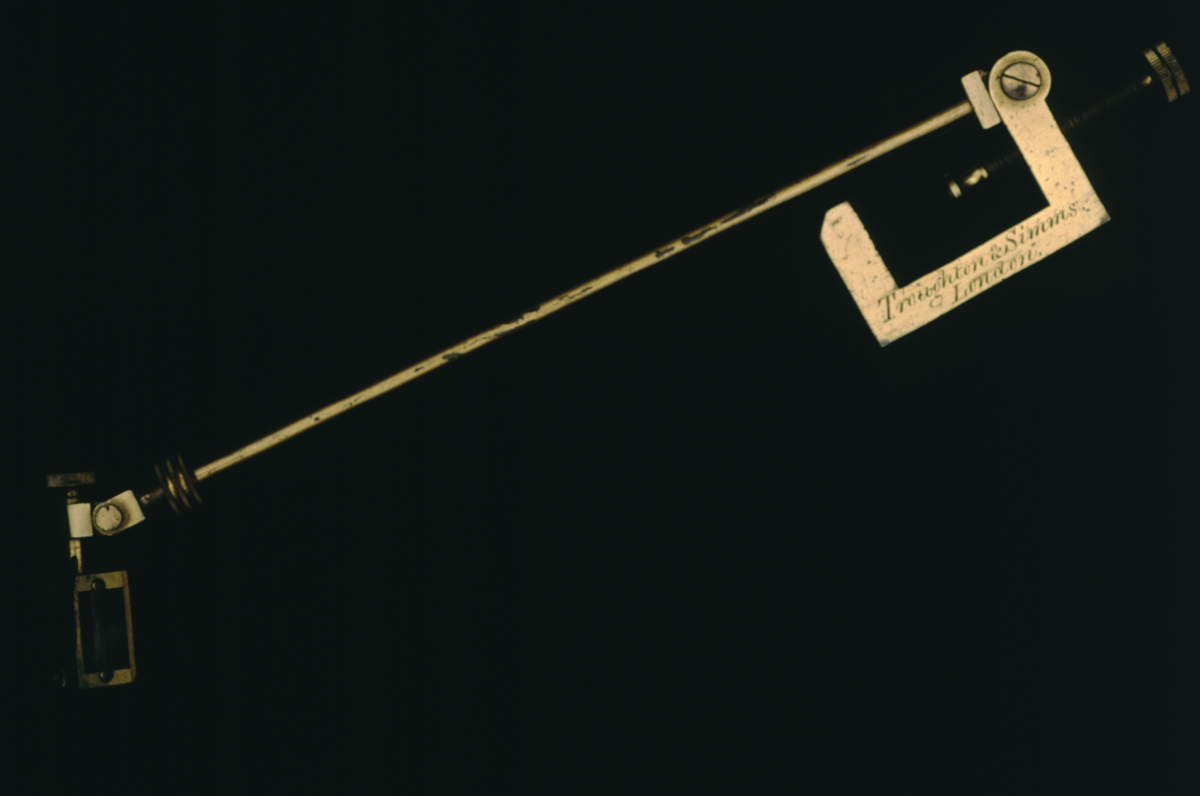
camera lucida, by Troughton and Simms, English, 1850 (c)
Origin
England; London
Maker
Troughton and Simms
Class
optical
Earliest Date
1850
Latest Date
1850
Inscription Date
Material
metal (brass); glass
Dimensions
height when closed 245mm; breadth 78mm; thickness 12mm
Special Collection
Provenance
Purchased from Christie’s, South Kensington, London, England; lot 203, 19/04/1982.
Inscription
‘Troughton & Simms,
London.’ (clamp)
Description Notes
Brass camera lucida. Clamp base, pivoted telescopic arm with clamp, rotatable prism with brass clamping screw and pivoted sight hole. Graduated on the stem: 2, 3, 4, 5, 7, 10, D[istance].
Condition fair (some tarnishing); complete.
References
Events
Description
The camera lucida (meaning “room of light”) was an aid for artists, surveyors, and architects. The camera lucida is a four-sided reflective prism on the end of a supporting arm. When positioned above a horizontal sheet of paper it worked by reflecting an image of the scene or document in front of the artist onto the paper to allow it to be copied, and the sliding bar could be adjusted to produce a reduced or enlarged image.
If an exact copy of an object was needed the prism would be positioned at equal distance from the object and the table. The further the object was from the table the more the image size would be reduced.
This particular camera lucida may have been made by William Hyde Wollaston, who originally invented them in the early 1800s.
23/05/2002
Created by: Izzie Foote on 23/05/2002
FM:40107
Images (Click to view full size):