Accession No
3498
Brief Description
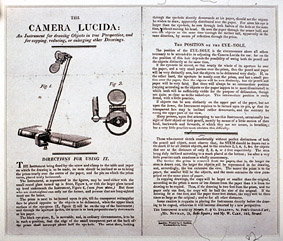
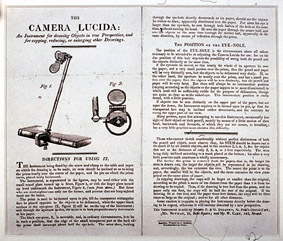
two page description of the camera lucida, printed by J. Barfield, English, 1800-1850 (c)
Origin
England; London
Maker
Barfield, J.
Class
prints; optical
Earliest Date
1800
Latest Date
1850
Inscription Date
Material
paper (card and another)
Dimensions
mounted: 322mm (height), 356mm (width), 4mm (depth)
Special Collection
Provenance
Inscription
‘THE
CAMERA LUCIDA:
An Instrument for drawing Objects in true Perspective, and
for copying, reducing, or enlarging other Drawings.’ (title)
Description Notes
Two page description of the camera lucida, with diagram of whole instrument and detail of optics. List of makers at end includes Dollond, Cary and Newman.
Pasted onto card and mounted.
Condition good; complete.
References
Events
Description
The camera lucida (meaning “room of light”) was an aid for artists, surveyors and architects. The camera lucida is a four-sided reflective prism on the end of a supporting arm. When positioned above a horizontal sheet of paper it worked by reflecting an image of the scene or document in front of the artist onto the paper to allow it to be copied, and the sliding bar could be adjusted to produce a reduced or enlarged image.
If an exact copy of an object was needed the prism would be positioned at equal distance from the object and the table. The further the object was from the table the more the image size would be reduced.
This particular camera lucida may have been made by William Hyde Wollaston, who originally invented them in the early 1800’s.
23/05/2002
Created by: Izzie Foote on 23/05/2002
FM:40111
Images (Click to view full size):