Accession No
0029
Brief Description
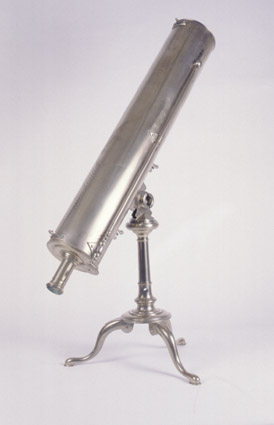
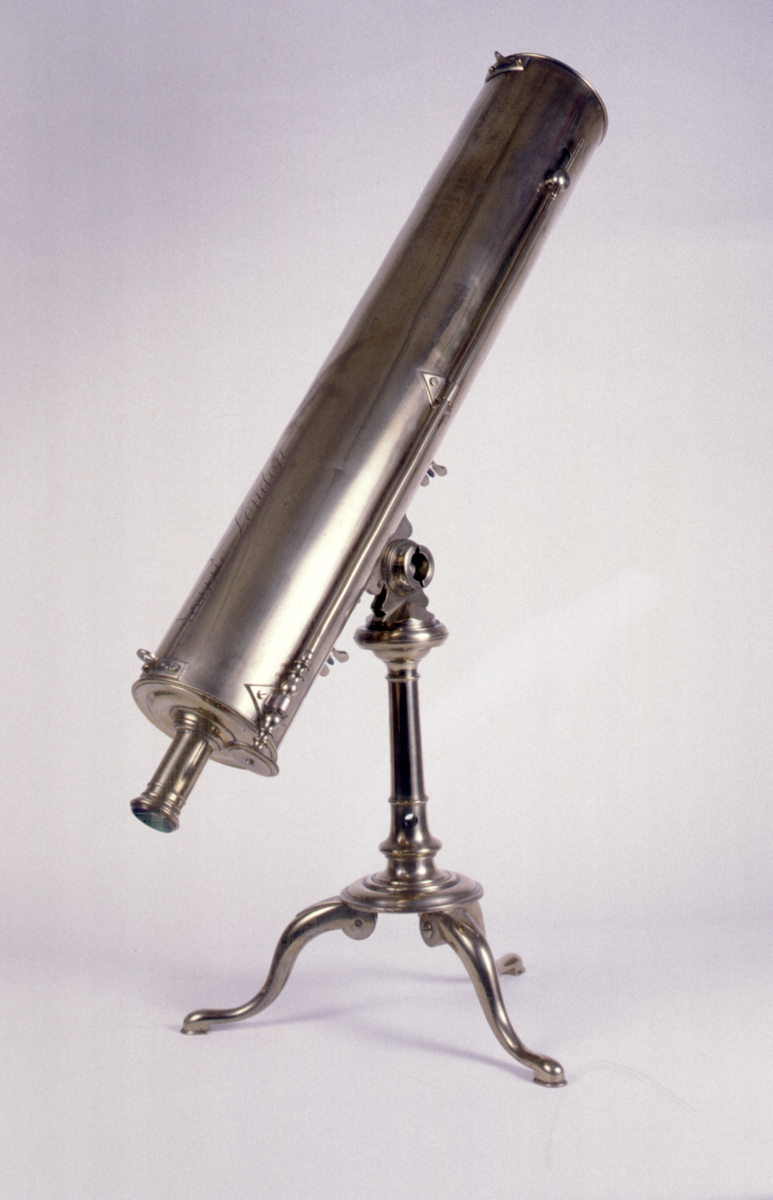
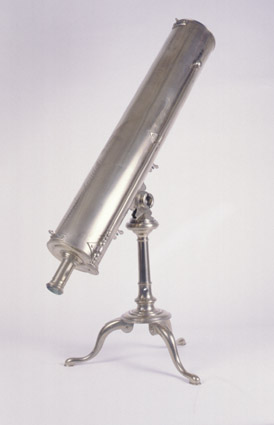
reflecting telescope, Gregorian, by Edward Nairne, English, 1760 (c)
Origin
England; London
Maker
Nairne, Edward
Class
astronomy; optical
Earliest Date
1760
Latest Date
1760
Inscription Date
Material
metal (brass, speculum); glass
Dimensions
telescope length 725mm; breadth of base 340mm; height 540mm; length (barrel) 645 mm; diameter 108 mm
Special Collection
Robert Whipple collection
Provenance
Purchased by Robert Stewart Whipple from T.H. Court, London, in 03/1922. Relacquered by the “Inst. Co.” at time of purchase.
Inscription
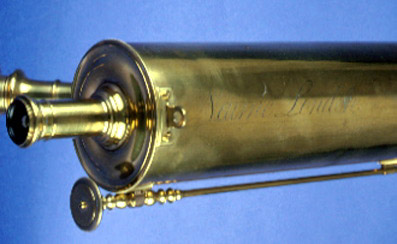
‘Nairne London ‘ (on barrel)
Description Notes
Gregorian reflecting telescope, brass. Barrel with friction- tight cover and open sights. Eye end (not readily removed) with screw-in eyepiece with screw-on aperture stop. Focus by long screw from eye end moving secondary speculum metal mirror. Primary mirror, speculum metal. 2 wing nuts secure barrel to altazimuth stand on pillar and folding tripod stand with cabriole feet.
Condition good; complete
References
Events
Description
In November 1944, R.S. Whipple’s donation to the University of Cambridge was put on show in the East Rooms of the Old Schools. The University accepted the donation on the condition that they found a new institution within which to house the collection.
Whipple himself wrote a guidebook to this exhibition, describing some of the more important objects and books on show. The front cover includes the following declaration: “The Exhibits are drawn from the Collection which Mr R.S. Whipple is presenting to the University and will form a nucleus for a History of Science Museum and Library in Cambridge.”
This 18th-century reflecting telescope was one of the objects displayed in the 1944 exhibition.
17/10/2025
Created by: Hannah Price on 17/10/2025
Description
Isaac Newton built the first reflecting telescope in 1669. Unlike a refracting telescope a reflecting telescope uses concave mirrors to focus light. The great advantage of using mirrors is that all colours of light are reflected equally. This was an improvement on the refracting telescope which used lenses to focus light. Here the light refracted at different angles to create a distorting fringe of colour around the image being observed.
At first high quality reflecting telescopes were difficult to make as the mirrors available to use degraded quickly and were unable to transmit enough light. But by the eighteenth century methods of making mirrors had improved and instrument makers such as James Short had created hundreds of reflecting telescopes for sale.
There are three types of reflecting telescope: the Gregorian, the Cassegrain and the Newtonian. Both the Gregorian and Cassegrain telescopes are pointed directly at the object being viewed. But the Newtonian has a secondary mirror set at 45° to the objective so the observer stands at right angles to the telescope. Today modern telescopes (with apertures greater than one metre) are reflecting telescopes. Various innovations make them more powerful and accurate. Computer controlled deformable mirrors can correct against changes due to atmospheric conditions or faults in the material.
Created by: Jenny Downes
FM:40132
Images (Click to view full size):