Accession No
0052
Brief Description
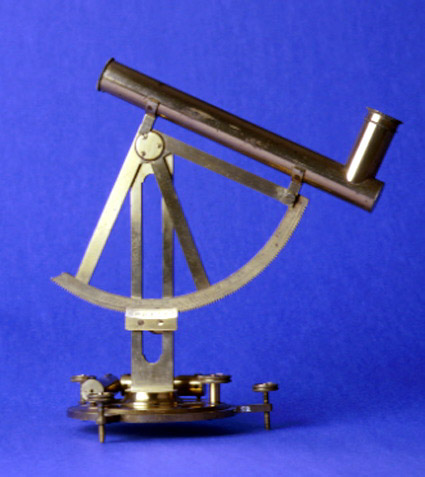
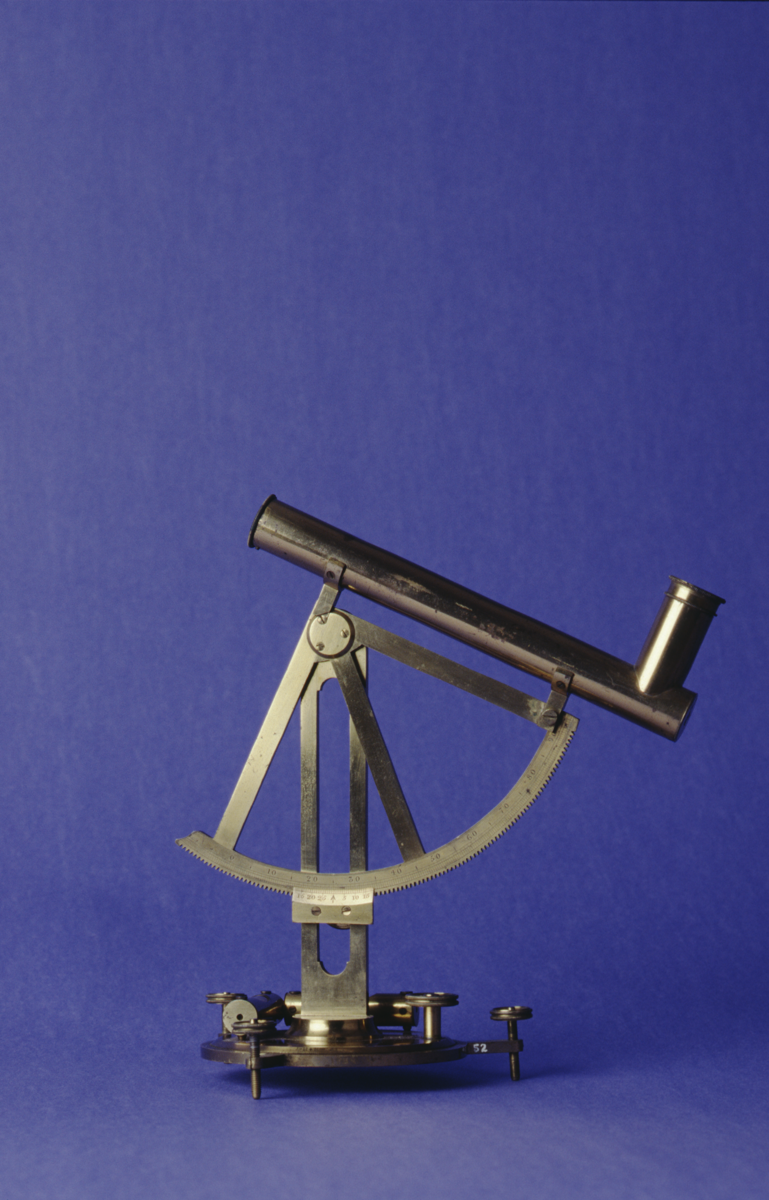
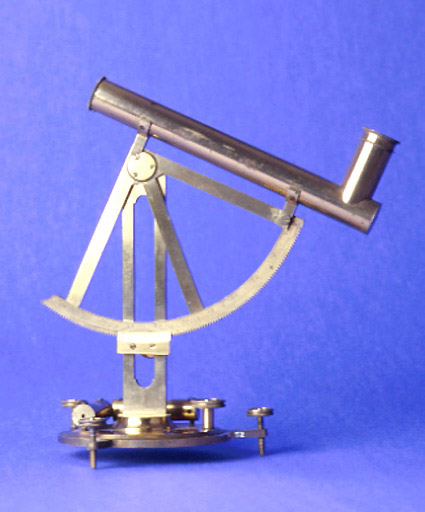
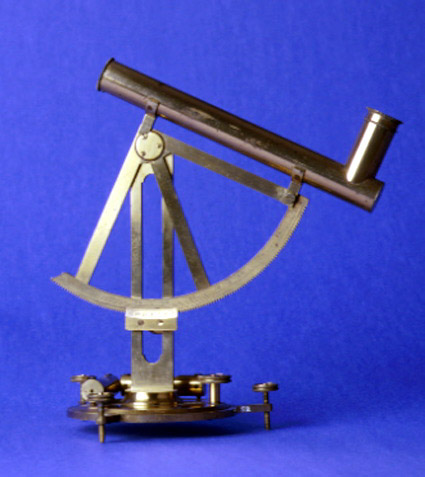
Quadrant by W. and S. Jones, c. 1800
Origin
London; England
Maker
W & S Jones
Class
astronomy
Earliest Date
1800
Latest Date
1800
Inscription Date
Material
metal (brass, oxidised brass); glass; liquid
Dimensions
telescope length 178mm; breadth of base 145mm; height 244mm
Special Collection
Robert Whipple collection
Provenance
Purchased by Robert Stewart Whipple in Sheffield in 07/1922.
Inscription
‘W. & S. Jones London:’ (base)
Description Notes
Pierced brass quadrant. Limb graduated [5˚] - 0 - [95˚], numbered by 10˚, subdivided to 30´, read by type A vernier to 1´. Controlled by knurled pinion operating along rack on limb. Telescope mounted on quadrant. Diagonal eyepiece. Screw-fit dark glass. Cross hairs. Quadrant mounted on stand over horizontal circle, graduated 0 - 90˚ - 0 - 90˚ - 0, numbered by 10˚, subdivided to 1˚. Read by A type vernier to 5´. Two bubbles on base plate with mutually perpendicular axes. Slow motion screw for horizontal circle. 3 levelling screws.
Condition fair (marking and tarnishing); complete.
References
Events
Description
Although Robert Stewart Whipple purchased his first antique instrument in 1913, it was not until the 1920s that his collection really began to grow. This quadrant is one of the first hundred objects that Whipple acquired, and demonstrates the early development of his taste for historic scientific artefacts and books.
07/10/2025
Created by: Hannah Price on 07/10/2025
Description
Quadrant
A quadrant is a quarter of a circle, and there are different types of instrument that come under that description. The size of quadrants varied hugely from Tycho Brahe’s highly successful huge 2m radius one, to the more portable versions of the 18th century. In all examples it was important to keep movement, wear and flexure to a minimum, especially if results were to form part of an extended research program and to be compared with one another.
The quadrant was the principle measuring instrument of astronomy in the 17th and 18th centuries, being used in all major observatories. Plain sights (where the angle was simply read off by eye) were replaced by telescopic sights in more sophisticated examples.
18/10/2002
Created by: Saffron Clackson on 18/10/2002
FM:40155
Images (Click to view full size):