Accession No
3761
Brief Description
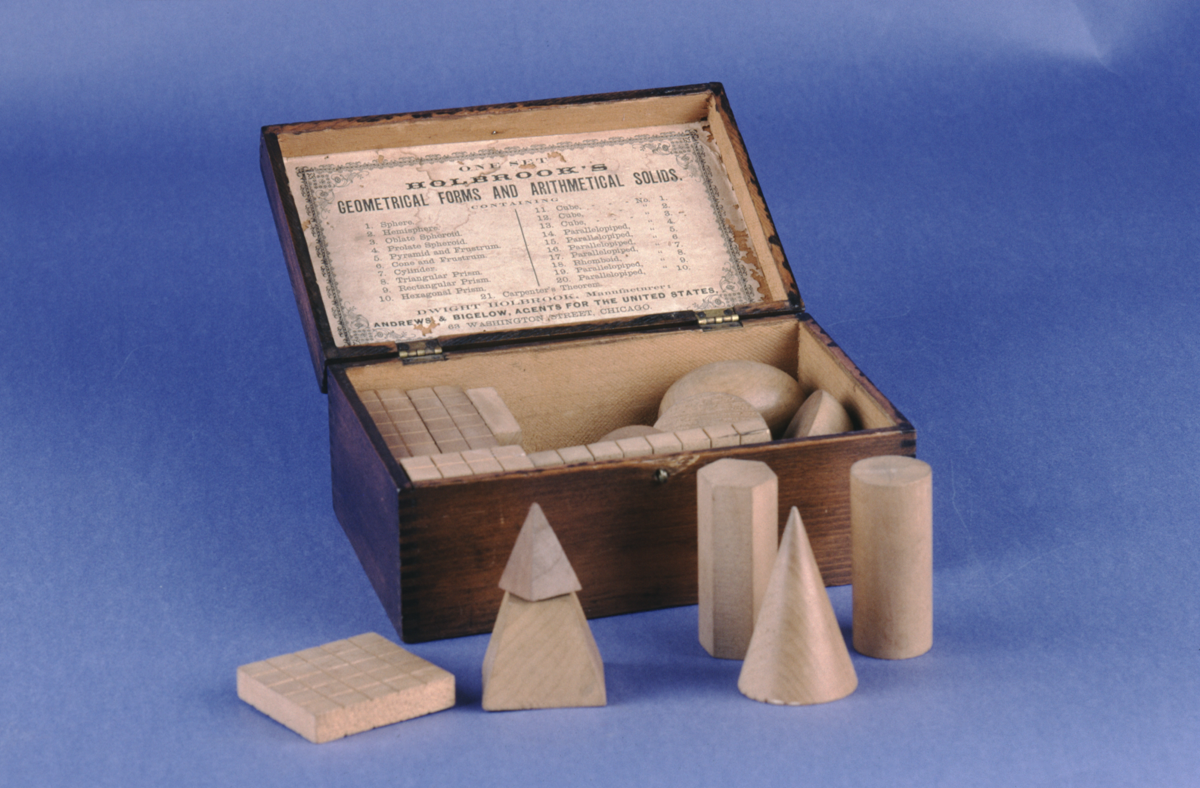
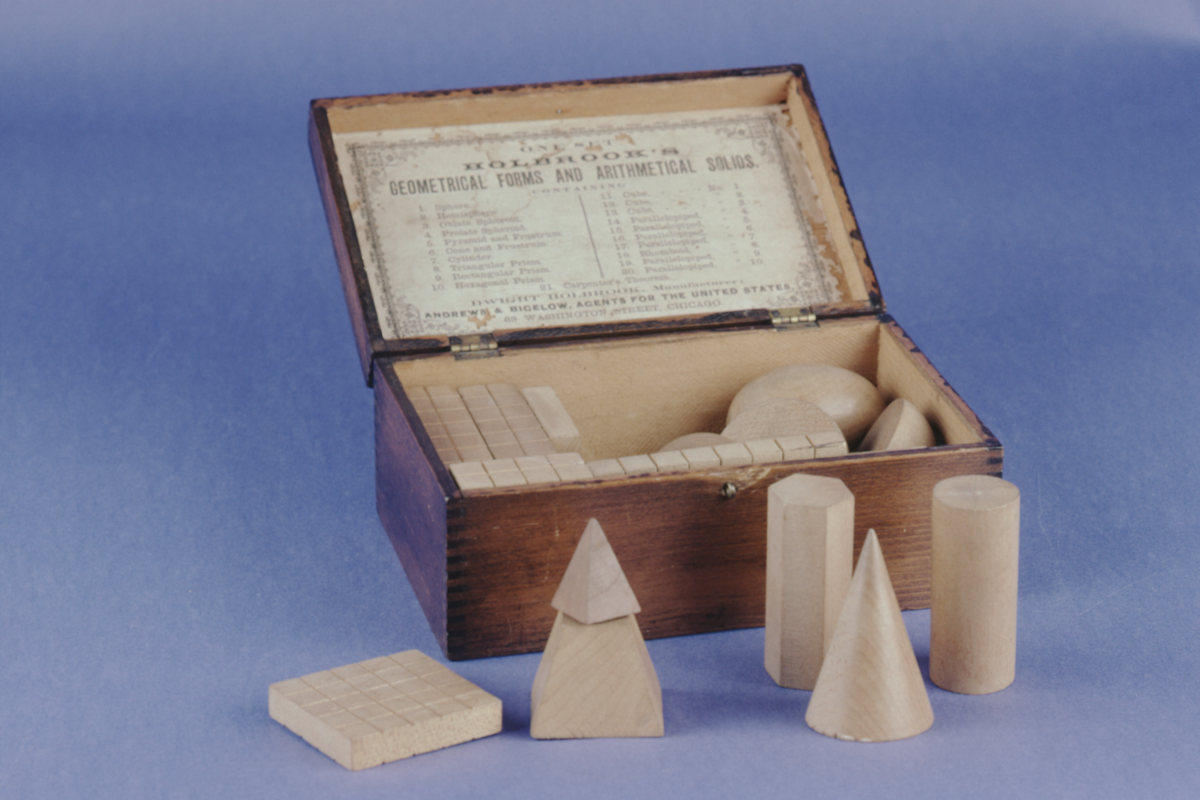
set of 26 wooden geometric solids, by Dwight Holbrook, U.S.A., late 19th Century
Origin
U.S.A
Maker
Holbrook, Dwight
Class
mathematics; demonstration
Earliest Date
1875
Latest Date
1900
Inscription Date
Material
wood (two types); metal (brass, steel); paper
Dimensions
box length 221mm; breadth 150mm; height 95mm
Special Collection
Provenance
Purchased from Tesseract, Hastings-on-Hudson, New York, USA, 1988.
Inscription
‘ONE SET
HOLBROOK’S
GEOMETRICAL FORMS AND ARITHMETICAL SOLIDS.’ (title on paper label in lid)
‘DWIGHT HOLBROOK, Manufacturer:
ANDREWS & BIGELOW, AGENTS FOR THE UNITED STATES,
63 WASHINGTON STREET, CHICAGO.’ (bottom of label)
Description Notes
Set of 26 wooden solids including spheroids, hemispheres, cones, prisms, cubes and a range of rectangular solids, etc. for instruction in geometry. Most of the rectangular solids are carved with grid pattern lines to unit squares to aid instruction in measuring solid bodies.
Wooden box with hinged lid (brass hinges) and brass hook fastener; paper label in lid.
Condition good (box fair, label eaten away around edge); complete (?)
References
Events
Description
The geometrical solids housed in this smart cabinet are intended to make geometry easier for the student. They serve the same purpose as diagrams in a textbook, but with the advantage of being three-dimensional. While diagrams can be very confusing, being able to actually handle an object lets you learn more readily.
During the eighteenth century the standard textbook for learning geometry was Euclid’s Elements of Geometry. Amazingly, this had been the main text since Euclid first compiled it in the 3rd century BC It is made up of a series of thirteen books, with the eleventh and twelfth of these dealing with ‘solid geometry’. It is for helping to understand the diagrams in these books that three-dimensional models come in useful.
Being such an elaborate set of solids, we can guess that these models would have been used in private tuition. However, we must also bear in mind their value as a display piece. Mathematics in the eighteenth century was a fashionable activity, something that showed one’s good taste. The educational and aesthetic functions are not entirely separate though. Being an attractive set, the models would have made learning more pleasurable.
Earlier sets of geometrical solids were often made to illustrate the ‘Platonic solids’ – the cube, tetrahedron, octahedron, dodecahedron and icosahedron. These were often regarded as having mystical significance. The astronomer Kepler used their properties as a basis for astronomical and astrological theories. Later sets of solids were often used for learning about the different crystals found in minerals.
FM:40182
Images (Click to view full size):