Accession No
1612
Brief Description
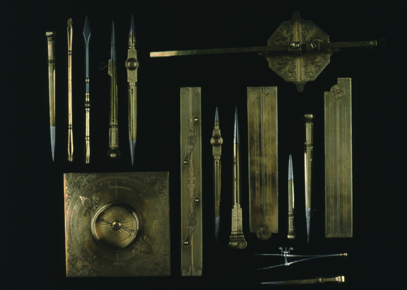
cased set of drawing instruments and set of Napier’s bones, by Domenico [Dominicus] Lusuerg, Italian, 1717
Origin
Italy; Rome
Maker
Lusuerg, Domenico [Dominicus]
Class
drawing
Earliest Date
1717
Latest Date
1717
Inscription Date
1717
Material
metal (brass, steel); wood; paper; rope (string); glass; hide (leather, suede)
Dimensions
box length 465mm; breadth 263mm; height 68mm; Napiers bones box length 76mm; breadth 58mm; thickness 10mm
Special Collection
Provenance
Purchased from Davidson Ltd., Jermyn Street, London, England, in 1972. Purchased with assistance of the Grant in Aid administered by the Victoria and Albert Museum and a grant from the National Art Collections Fund. Originally from a private American collection.
Inscription
‘Dominicus Lusuerg
F. Romæ. Ao. 1716 ‘ (on sector)
‘Dominicus Lusuerg F. Romæ 1717 ‘ (on protractor, quadrant, compass, level, rule and protractor)
‘Dominicus Lusuerg ‘ (on 2 dividers)
‘Dominicus Lusuerg F. Romæ ‘ (on beam compass and three legged compasses)
Description Notes
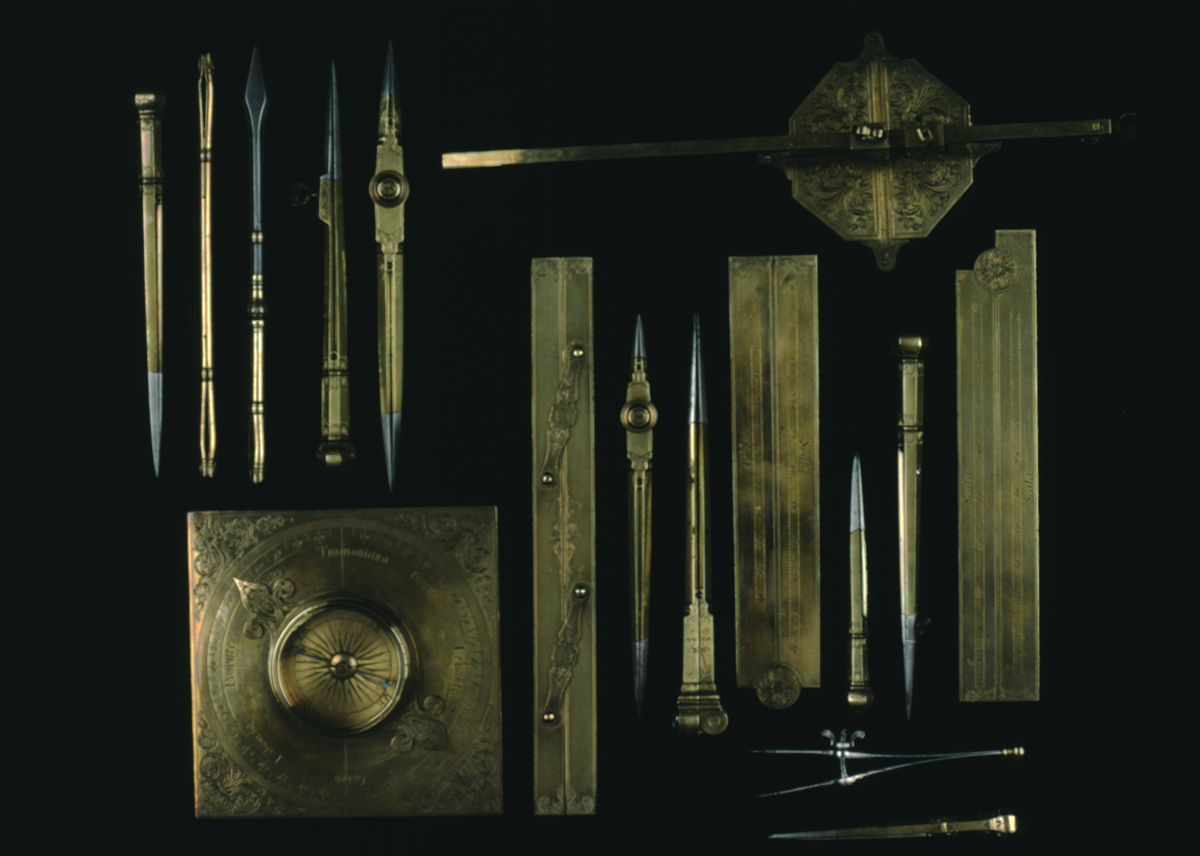
Cased set of drawing instruments; and set of Napier’s bones, by Domenico [Dominicus] Lusuerg, Italian, 1717.
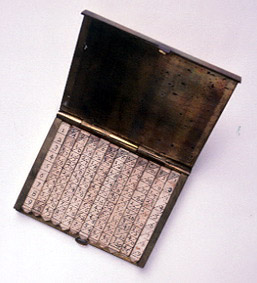
Napier’s bones consist of a set of 10 rods, with additional rods for squares and cubes, in a brass case. The tables of numbers are printed on paper applied to the wooden rods.
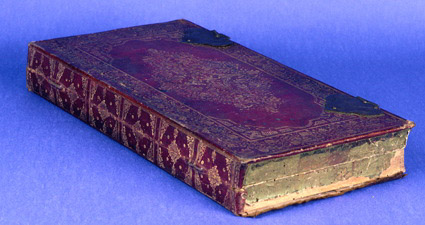
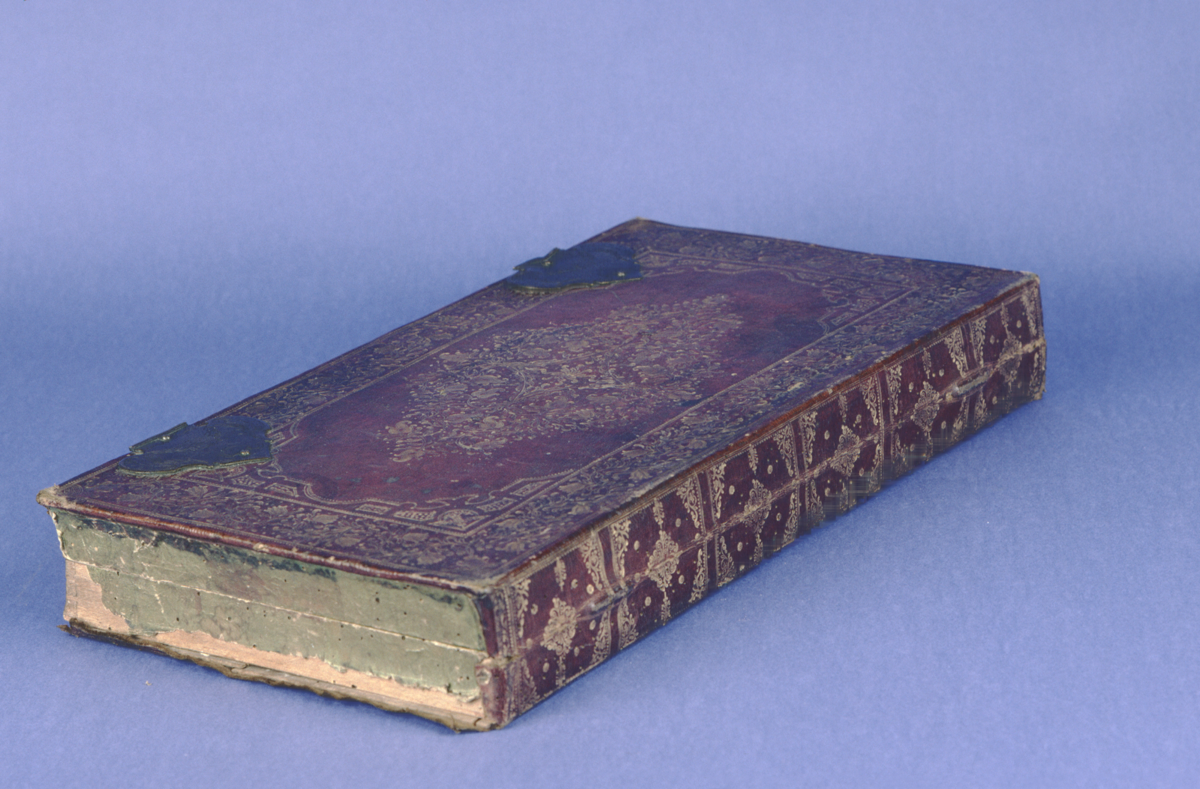
Fitted wooden box with central hinge covered in gold-tooled maroon (/brown) leather and lined with soft red leather. Interior with 2 trays marked ‘A’ and ‘B’. Top tray holds:
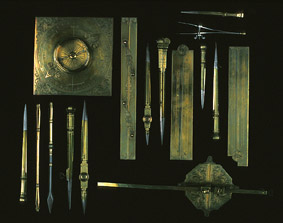
1. a pair of 3 legged compasses with steel points. Shoulders decoratively engraved.
2. pair of dividers with steel points. One limb has point let in, the other limb the steel point is let in along the whole length and may be sprung out by a brass thumb screw. Shoulders decoratively engraved.
3. pair of beam compasses. On back lined scale divided 0 - 120, numbered by 10, subdivided to 1 [unit not stated: 120 = 170mm]. One steel point, one brass pencil holder. Pair of brass beam heads with thumb screws all decoratively engraved, feet for trammel. Brass trammel with steel points, the face engraved with decoration.
4. pair of steel spring bows; brass knob. Adjusting screw allows scribing of arcs up to 27mm
5. set of Napier’s rods (see description above)
6. compass: central glass-covered compass moves over degree scale divided [0] - 90 - [0] - 90 - [0] numbered by 10 graduated to 1 and marked with the 8 winds in Italian. 64-point rose.
7. protractor. Pierced semicircle with square at right hand. Calibrated 0 - 180˚, numbered by 10˚, subdivided to 1˚. On the diameter a ‘Scala’ divided -10 to 0 to 50, numbered by 10 [unit not stated; 50 = 93mm]. Reverse with engraved decoration
8. sinical quadrant (gunner’s quadrant). Divided 0 - 90˚ and 90˚ - 0, numbered by 10˚, subdivided to 30´, with Vernier on the alidade (after P. Vernier). A pierced quadrant of 30˚ with sights on each limb rotates around the apex of the quadrant; the sector divided into 30 parts (equivalent to 30˚ 30´), reading to 1´. Decoratively engraved slit-peep and window sights. Quadrant divided with rectilinear network 0 - 90˚, numbered by 10˚, subdivided to 1˚; the alidade similarly calibrated. Also two ‘Schala [sic] Altimetra’ divided 0 - 100, numbered by 10, subdivided to 1 (each scale over 45˚). Reverse carries artillery scale ‘Pro Eleuatione Bombardae’ divided 6 - 0 - 6, numbered by 1, subdivided to 0.1; vignette of canon and quadrant in use. Socket with ball joint and slot (for tripod).
[Space for (probably) pair of dividers - missing]. Also two unnumbered spaces (for pencil holders?).
The lower tray contains:
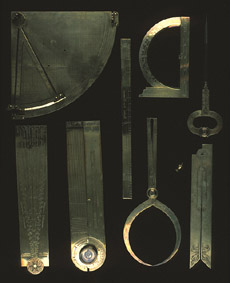
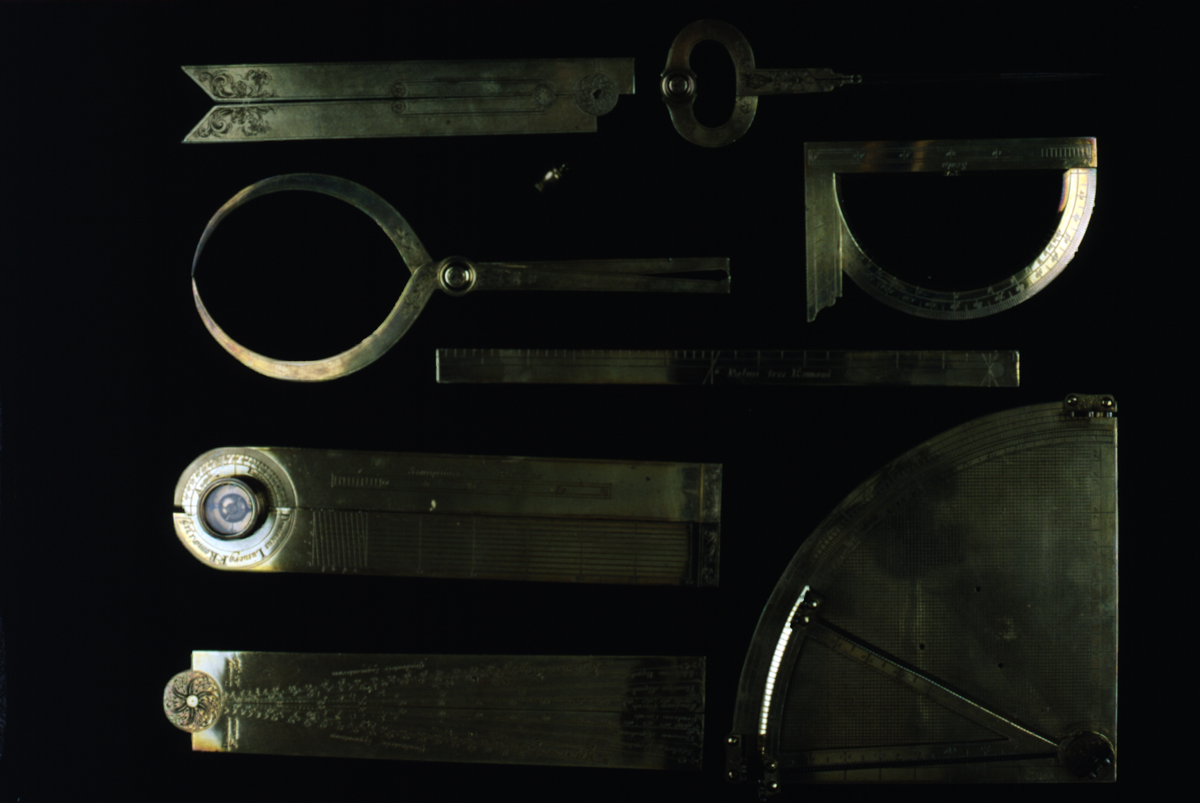
1. 2 pairs of proportional dividers with steel points; engraved decoration on shoulders. One in 1:3 ratio; one in 1:2 ratio.
2. pair of single-handed dividers with steel points; engraved decoration on shoulders.
3. 2 pen and pencil holders; brass double-ended pencil holder and combined brass pencil holder and steel pen.
4. pair of callipers; two pairs of limbs for external and internal measurements; engraved decoration on and around the hinge.
5. rule in 3 hinged sections. Obverse: ‘Palmi tres Romani’ graduated 0 - 12, [0] - 12, [0] - 12, numbered by 3, subdivided to 0.5 and to 0.2. Reverse: ‘Pedes duo Gallici’, graduated 0 - 12, numbered by 3, subdivided to 0.1.
6. sector with decoratively engraved hinge with double lines of ‘Quadratix Segmentorum’, ‘Solidorum Regularium’, ‘Planorum Æqualium’, ‘Graduum Circuli’. Reverse has double lines of ‘Metallorum’, ‘Figurarum Regularium’, ‘Planorum’, ‘Solidorum’ and ‘Partium Æqualium’.
7. combined rule and protractor. Two hinged limbs with radial protractor at the hinge; protractor marked ‘Anguli Interiores’ and divided 0 - 180˚ and marked ‘Anguli Exteriores’, divided 0 - 180˚; both numbered by 10˚, subdivided to 1˚. On the index limb a glazed compass box set on the hinge, with 4 cardinal points. The index limb obverse has a linear diagonal scale marked 10 - 0 - 60, numbered by 10, subdivided to 0.1. The other limb obverse with linear scale of ‘Semipalmus Romanus’ divided 0 - 60, numbered by 10, subdivided to 0.5. Index limb reverse with linear scale of ‘Semipes Romanus’ divided 0 - 60, numbered by 10, subdivided to 0.5. Other limb reverse with linear scale of ‘Semipes Gallicus’ divided 0 - 60, numbered by 10. On hinge a scale of ‘Pro Eleuatione Bomardæ’ divided 6 - 0 - 6, numbered by 1, subdivided to 0.1.
8. three pairs of dividers with steel inlet points and decoratively engraved shoulders. One with choice of steel point, steel pin point, brass dotting wheel or brass pencil holder.
9. folding square. Ruling edges undercut. Decoratively engraved hinge. On each limb a ‘Scala’ divided 10 - 0 - 70, numbered by 10, subdivided to 0.5 and 10 - 0 - 90, numbered by 10, subdivided to 0.5. Reverse is plain but hinge decorated.
10. folding level with detached urn-shaped plumb bob. The cross piece calibrated 45˚ - 0 - 45˚, numbered by 10˚, subdivided to 1˚. Decoratively engraved at the hinge points and the feet. Similar decoration on the reverse, which is otherwise plain.
11. folding straight edge. ruling edge undercut. On each limb a ‘Scala’ divided 10 - 0 - 90, numbered by 10, subdivided to 0.5 (two scales are of different lengths).
Also further pair of dividers with steel points.
Condition good (box in poor condition, missing clasp); complete
References
Events
Description
Dominicus Lusuerg made this set of richly decorated mathematical instruments in Rome, where he was a master craftsman ‘Fabricatore d’Instromenti Matematici’. As a fine engraver as well as instrument maker, Lusuerg likely catered for the growing early 18th century market in mathematics as a fashionable pursuit for educated gentlemen. While the practical needs of an architect, draughtsman, gunner or surveyor could be satisfied with plain and functional instruments, finely crafted instruments such as these – presented in a leather bound case with gold tooling – were probably made to order for the library of an Italian nobleman.
07/05/2008
Created by: Joshua Nall on 07/05/2008
FM:40189
Images (Click to view full size):