Accession No
2835
Brief Description
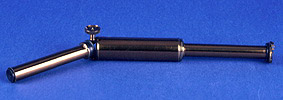
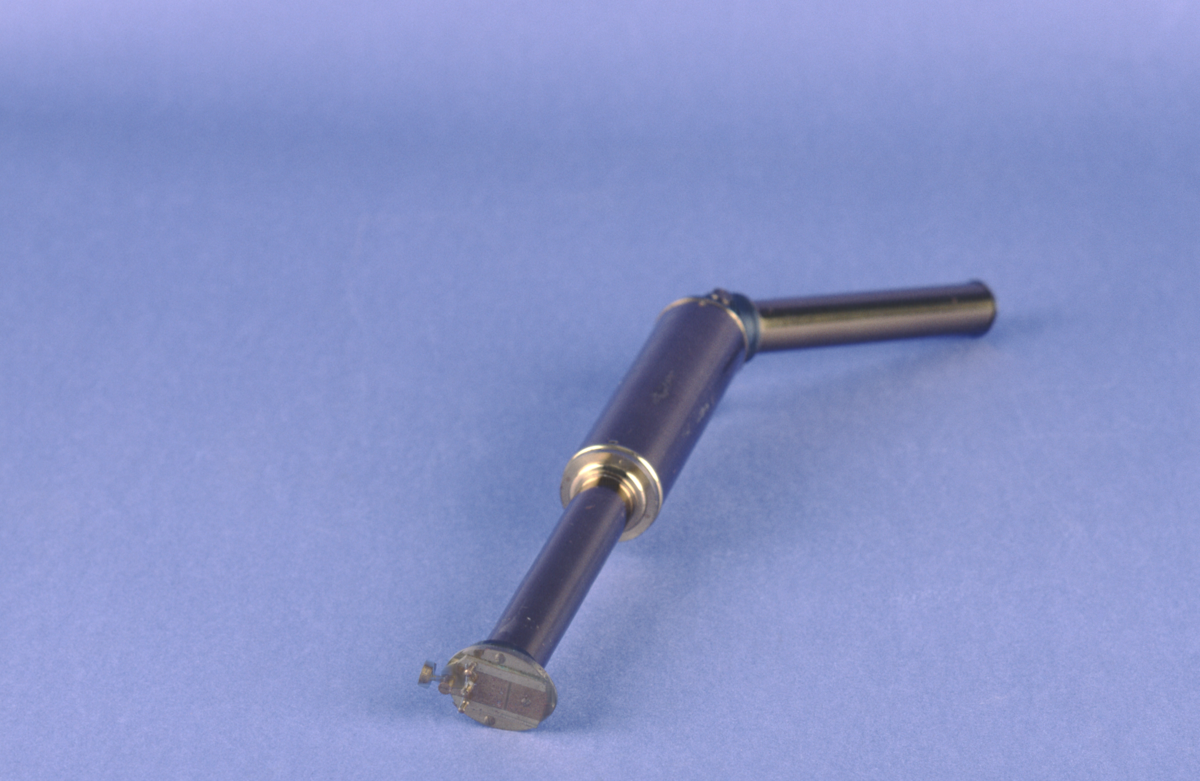
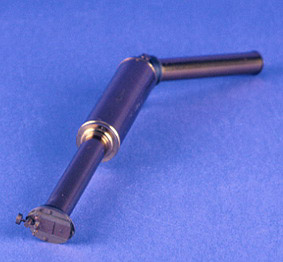
direct-vision spectroscope, by John Browning, English, 1880 (c)
Origin
England; London
Maker
Browning, John
Class
optical
Earliest Date
1880
Latest Date
1880
Inscription Date
Material
metal; brass; glass
Dimensions
overall length 435mm box length 181mm; breadth 129mm; height 68mm
Special Collection
Provenance
Purchased from Christie’s, South Kensington, London, England, 20/04/1982.
Inscription
John Browning
London (main tube)
Description Notes
Direct-vision spectroscope, by John Browning, English, c. 1880.
Brass direct vision microscope. Slit, brass jaws, width adjustable by brass screw (drumhead divided 0 - 10, numbered by 1) moving against spring. Collimator screws into body of instrument housing prisms. Screw-in telescope pivots on body, clamped by knurled screw. Screw-in eye-piece on draw tube. Spare eyepiece and draw tube. Fitted mahogany box storing spectroscope in three pieces.
condition good.
References
Events
Description
In 1814, Joseph von Fraunhofer noticed that the sun’s spectrum, when dispersed by a glass prism, is crossed by hundreds of fine dark lines. These lines could be used to determine the chemical composition of the sun, stars, and many other substances by spectral analysis. The first photograph of the spectrum of a star (Vega) was made by Henry Draper using a spectroscope in 1872.
There are various different forms of spectroscope, but all use a slit and collimator to make a parallel beam of light, a prism for dispersing different wavelengths, and a telescope to observe the dispersed spectrum.
18/10/2002
Created by: Saffron Clackson on 18/10/2002
FM:40371
Images (Click to view full size):