Accession No
3840
Brief Description
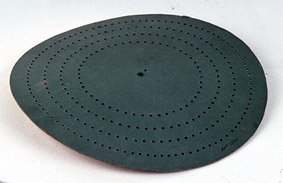
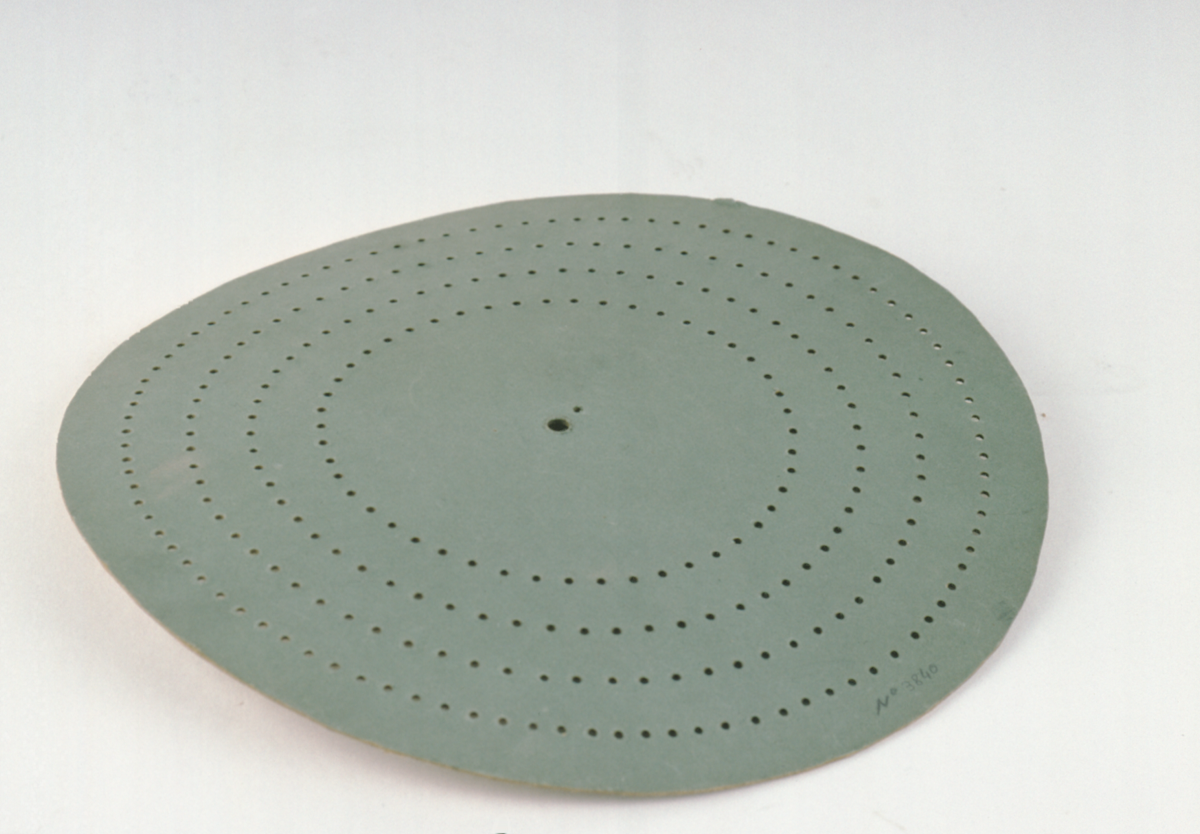
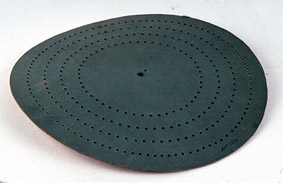
siren disc, late 19th century - early 20th century
Origin
Maker
Class
sound
Earliest Date
1850
Latest Date
1950
Inscription Date
Material
paper (cardboard)
Dimensions
diameter 280mm
Special Collection
Provenance
Donated by King’s College, University of London, London, England, 1992.
Inscription
Description Notes
Cardboard disc with four concentric circles of punched holes. Central hole for axis; one hole offset from centre.
Condition good (some staining); complete
References
Events
Description
The siren is a device for the mechanical production of sound. The instrument is important in the history of the scientific study of sound because it was the first sound source developed that could produce many different sounds of known frequencies. Invented by the French Engineer and Physicist Charles Cagniard de la Tour in 1819, the instrument gets its name due to its ability to produce sound underwater (the Sirens were female creatures of Greek mythology that lured sailors to their deaths by sweet singing).
In its most simple form the siren consists of two metal disks, each perforated with equally spaced concentric holes. One disk forms the top of the “wind chest” while the other rotates close to the first. Air is forced through the system, which causes the upper disk to rotate, owing to the slanted bore of the holes. As the disk rotates the flow of air is periodically cut off and reinstated resulting in a regular emission of puffs of air. The ensuing fluctuations in air pressure set up simple sound waves of a specific frequency depending on the speed of rotation of the upper disk. De la Tour arranged for the upper disk to drive a counter that can show how many revolutions per second were produced. Knowing how many holes there are in the disks, and thus how many puffs of air per rotation, one can immediately calculate the exact frequency of the sound produced.
Originally the siren was developed for experiments in acoustics; notably, it was used extensively by the German physicist Herman von Helmholtz, featuring in his seminal 1863 work on acoustics, Die Lehre von den Tonempfindungen als physiologische Grundlage für die Theorie der Musik (On the Sensations of Tone as a Physiological Basis for the Theory of Music). Nowadays the siren (albeit in electronic versions) is used for danger warnings, but it has also been used in classical music, for instance in Edgar Varese’s composition Ionization.
08/05/2008
Created by: Dr. Torben Rees on 08/05/2008
FM:40399
Images (Click to view full size):