Accession No
4505
Brief Description
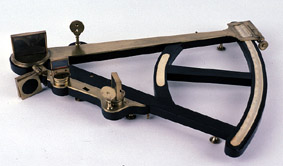
ebony and brass octant in box by W & S Jones late 18th C
Origin
London; England
Maker
W & S Jones
Class
navigation
Earliest Date
1795
Latest Date
1795
Inscription Date
Material
wood; ebony; metal; brass; ivory; glass
Dimensions
radius 383mm; index arm 405mm
Special Collection
Provenance
Inscription
‘W & S, Jones,
30 Holborn London’ (index arm)
Description Notes
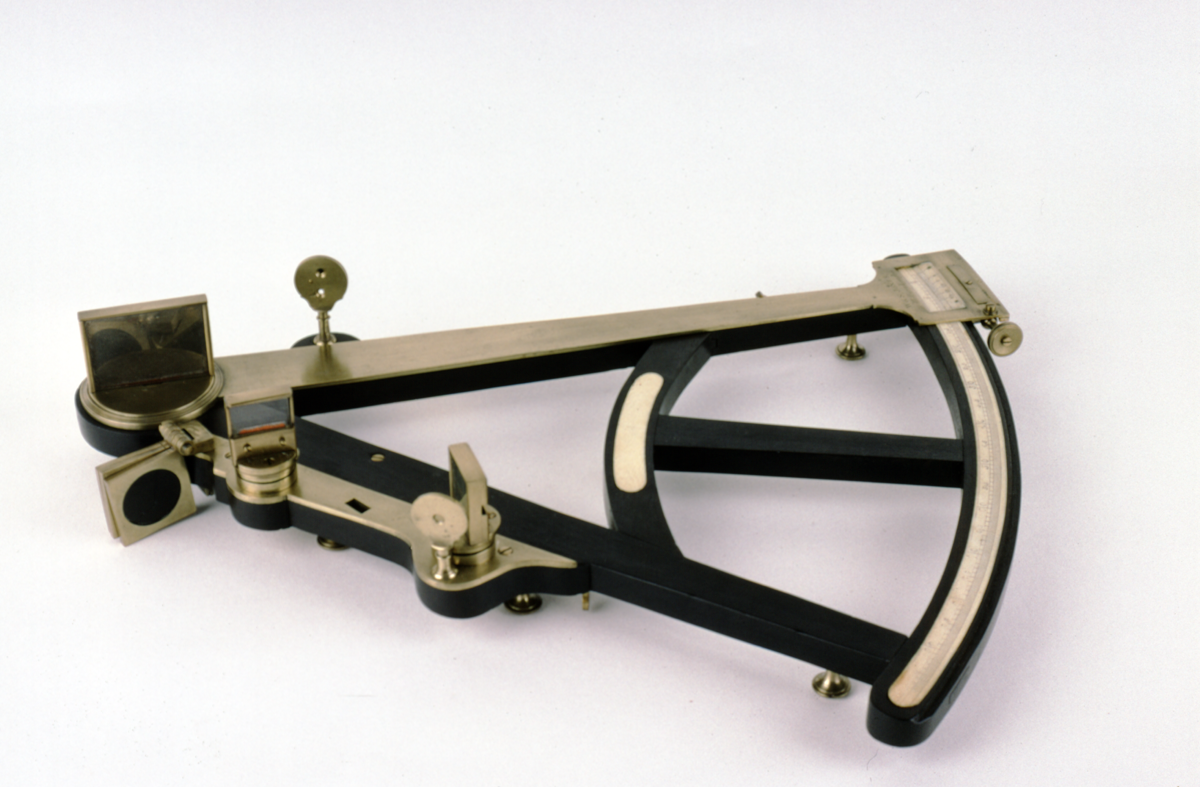
Octant. Ebony frame; ivory scale divided clockwise [2˚] - 0 - 90˚ - [98˚], numbered by 10˚, graduated to 20´. Brass index arm with ivory, type-B vernier and brass clamp and tangent screws. Brass mounts for mirrors and shades. Adjustable index mirror with three shades. Horizon glass with lever adjustment. Brass double pinhole sight. Backsight (single pinhole) and back horizon glass with lever adjustment. Inset ivory plate and ivory note plate on reverse. Six brass feet.
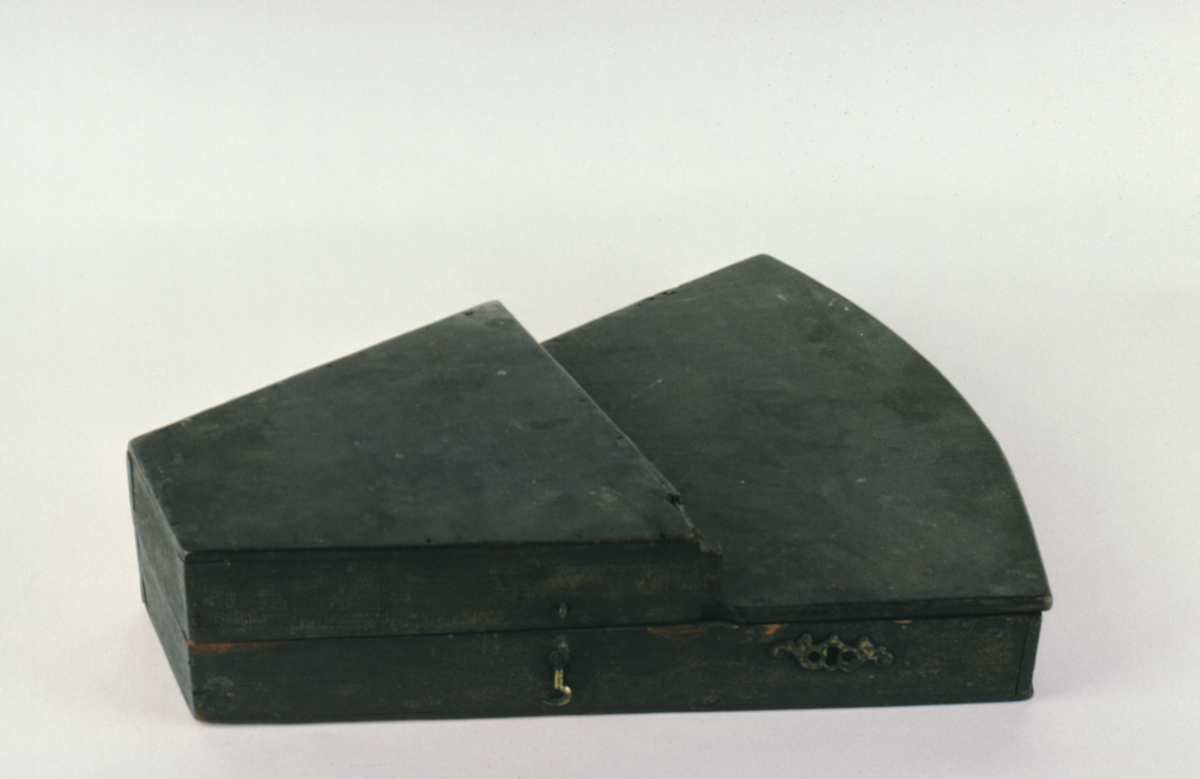
Original step wooden box.
Condition good; incomplete (pencil missing)
References
Events
Description
John Hadley, an English seafarer, invented the octant (also called a Hadley quadrant) during the 1730’s. It was used to find latitude by measuring the altitude of the sun, moon or stars.
An octant is an angle of 45°, or an eighth of a circle. The octant was first made with mahogany frames and scales on inlaid boxwood. By the early 19th century ebony (a much more hard wearing wood) had replaced the mahogany to craft the frames which had brass index arms.
The octant is used in a similar way to a sextant. The observer raises the octant until the horizon can be seen through the horizon glass. The index arm and attached index glass are moved until the twice-reflected image of the sun or star can be seen superimposed on the horizon, enabling an angle to be read off.
The octant was inexpensive and became the everyday instrument for measuring latitude, whilst the more expensive sextant was used to find longitude by measuring lunar distances.
Created by: Corrina Bower
FM:40431
Images (Click to view full size):