Accession No
1970
Brief Description
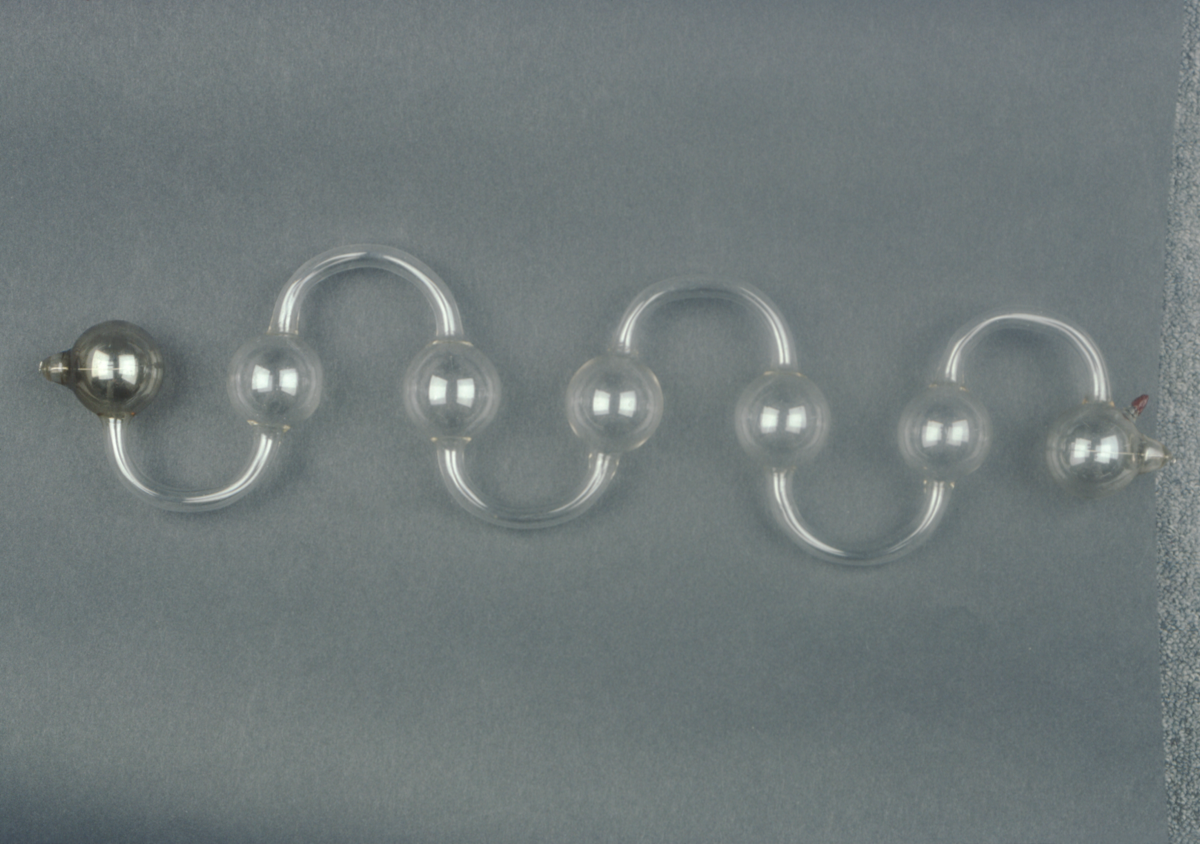
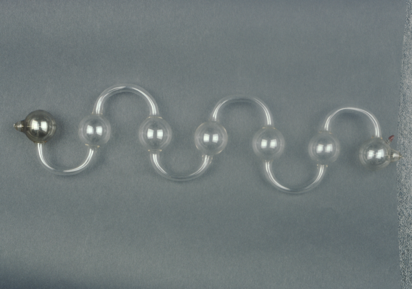
3 glass discharge tubes, 1875-1925
Origin
Maker
Class
physics
Earliest Date
1875
Latest Date
1925
Inscription Date
Material
glass; metal (silver, copper, aluminium, white metal); wax
Dimensions
1970.1 length 480mm; beadth 120mm; thickness 35mm; 1970.2 length 375mm; breadth 120mm; thickness 40mm; 1970.3 length 445mm; breadth 103mm; thickness 40mm
Special Collection
Cavendish collection
Provenance
Transferred from the Cavendish Laboratory, University of Cambridge, in 1974.
Inscription
Description Notes
3 blown glass vacuum tubes in form of triple S with spherical chambers joining each semi-circle.
1970.1 has silvering on internal faces of end spheres
Condition good; complete
References
Events
Description
Glass has been prized for centuries for its transparency and moldability. It’s these qualities that make it one of the most important materials in the history of physics. The Whipple cares for a large collection of glassware from the University of Cambridge’s Cavendish Laboratory of Experimental Physics.
Most of it dates from the 1880s to the 1930s, when Cavendish Professor J.J. Thomson and his students were studying the mysterious glows and rays that can be seen through the glass when electricity is run through a gas in a partial vacuum. These studies led to Thomson’s discovery that cathode rays were made up of sub-atomic negatively charged particles in 1897. He named them corpuscles: we know them as electrons.
The Laboratory’s technical team included gifted glassblowers. They created and repaired the intricate vessels to order: whatever the researcher needed for his or her experiments.
Many of the technicians joined the Laboratory as young boys and remained there throughout their careers. This meant there was an unbroken continuity of craft and technical knowledge across the Laboratory’s first six decades.
Scientific glassblowers work with prefabricated tubes of set diameters and thicknesses. They use a flame and their own breath to expand and bend them into the shapes needed for each experiment.
At the Cavendish Laboratory, all students were encouraged to learn glassblowing, but it was very difficult to master.
“Only those who have tried it know how exasperating glass-blowing can be, and how often when the apparatus is finished it breaks and the work has to be begun again.”
J.J. Thomson, Cavendish Professor, 1936
These intricate forms were blown and shaped using standard glass tubing. It would take the craftsman about half a day using a pump to remove the air from one tube. It might then be filled with a specific (sometimes hazardous) gas, such as helium. It contains metal terminals to enable an electric current.
10/07/2025
Created by: Hannah Price on 10/07/2025
FM:40453
Images (Click to view full size):