Accession No
4612
Brief Description
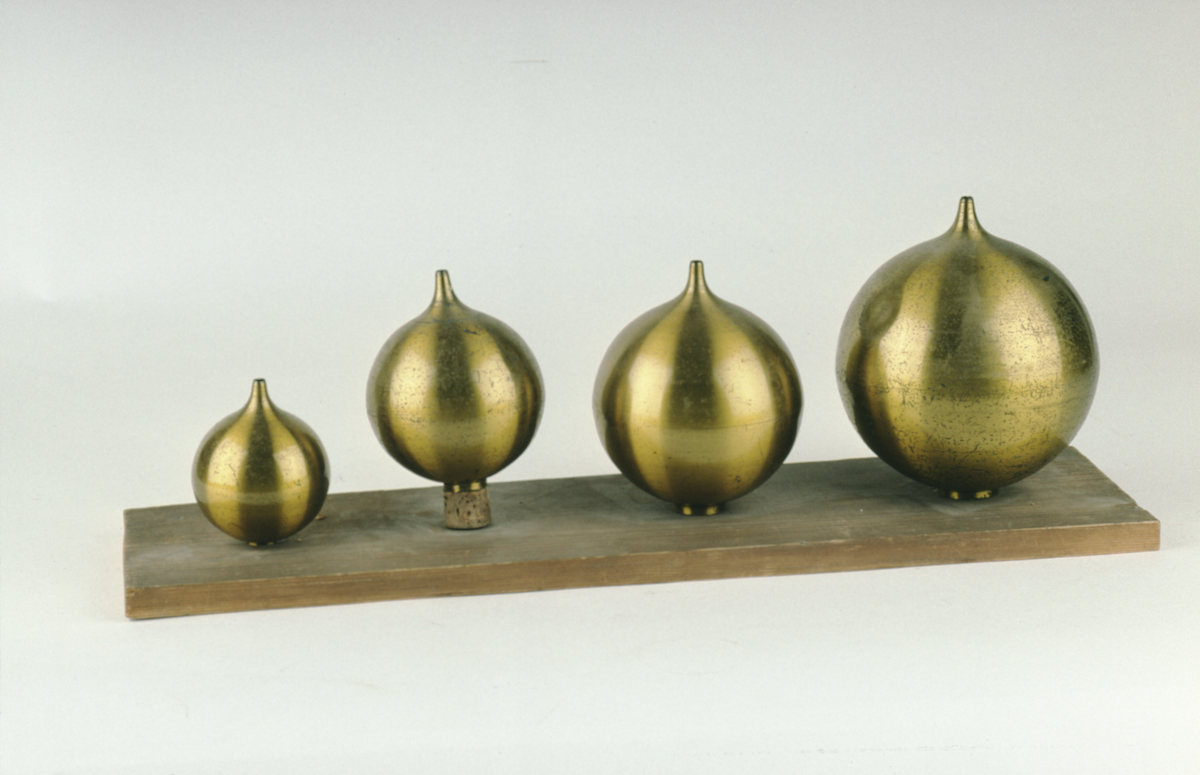
set of four Helmholtz resonators on a wooden plinth, second half 19th century
Origin
Maker
Class
physics; laboratory apparatus; sound
Earliest Date
1850
Latest Date
1900
Inscription Date
Material
wood (cork and one other); metal (iron, brass)
Dimensions
overall length 512mm; breadth 152mm; height 190mm
Special Collection
Provenance
Purchased on 09/06/1997.
Inscription
Description Notes
Four Helmholtz resonators on a wooden plynth, arranged in order of size. The notes are marked on the stand in front of each resonator: 256 C (largest); 320 E, 384 G, 512 C. Resonators set on cork-covered nails (cork for smallest resonator has come away and is wedged into the resonator). The cork for the largest resonator is unstable.
Condition fair (largest resonator dented); complete.
References
Events
Description
This set of brass resonators is a tool for analysing complex sounds. The pointy end goes in your ear and the air passes over the hole in the other side. This helps you to pick out a particular tone in a sound.
All sounds are made up of vibrations at a mix of different frequencies, depending on how they are created. Each resonator in the set allows the user to identify a different frequency within the sound. The smaller the resonator, the higher the frequency.
This works thanks to a phenomenon called Helmholtz resonance. When air is forced in and out of a cavity, it causes the air inside to vibrate at a specific natural frequency. You can try this yourself by blowing across the top of a bottle to create a resonant tone.
22/07/2024
Created by: Hannah Price on 22/07/2024
Description
Helmholtz resonators are instruments used for the practical analysis of the composition of sound by means of the idea of ‘resonance’. This set consists of ten resonators held together in a wooden stand. Each of the brass spheres resonates, or vibrates, if they are exposed to a sound containing a harmonic whose frequency was equal to or close to the resonant frequency of the sphere. This causes the resonator to amplify the harmonic so that it can be heard separately. When air is forced into the resonator, as is the case with sound causing movement of air particles, the pressure inside increases. Once the external force that pushes the air into the resonator disappears, such if the sound is turned off, the higher-pressure air will flow out due to the elasticity of the medium. However, this results in the resonator containing a slightly lower pressure than outside, causing air to be drawn back in, repeating the process. Therefore, the sound in the resonator persists after the original sound stops.
Helmholtz asserted that sound waves are composed of waves of various different frequencies, which are referred to as harmonics or partials. By placing one’s ear next to the cylindrical opening in each resonator, it is possible to hear the sound of an isolated harmonic. Different sized spheres resonate at a different frequency because of the varying pressures that they put on the moving air that sound produces. By using a combination of resonators of different sizes, Helmholtz was able to identity and estimate the relative strengths of the separate harmonics present in a complex mixture of tones.
Hermann von Helmholtz (1821-1894) was a German physicist and philosopher who studied a wide range of scientific areas. He began his work on acoustics and sound in 1856, culminating with the groundbreaking publication of On the Sensation of Tone as a Physiological Basis for the Theory of Music in 1863. Helmholtz applied the mathematical ideas of François Marie Charles Fourier (1772-1837) to the question of tonal quality, or timbre. Fourier had invented a type of mathematical analysis that could prove that any periodic sound wave can be represented as the sum of sine waves having the appropriate amplitude, frequency and phase. This gave way to Helmholtz’s reductionist ideas of sound, whereby all complex sounds are made up of simple tones. Helmholtz further applied these ideas to the human perception of sound, arguing that our ears analyze sounds in a similar way to his resonators, with vibrations of different frequencies being extracted from the sound and sent to different nerve endings.
Rudolph Koenig (1832-1901) also played a large part in the practical aspects of the development of the resonators. A glass version of the resonators was one of the first instruments built at Koenig’s workshop in winter of 1859-60. By 1865, he had developed his better-known brass resonators that became standard for physical and psychological laboratories around the world.
14/04/2008
Created by: Jonah Lipton on 14/04/2008
FM:40533
Images (Click to view full size):