Accession No
2018
Brief Description
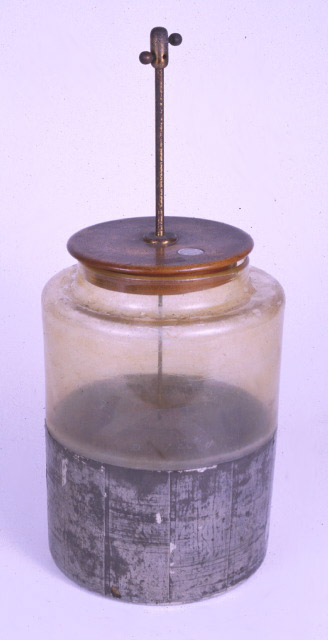
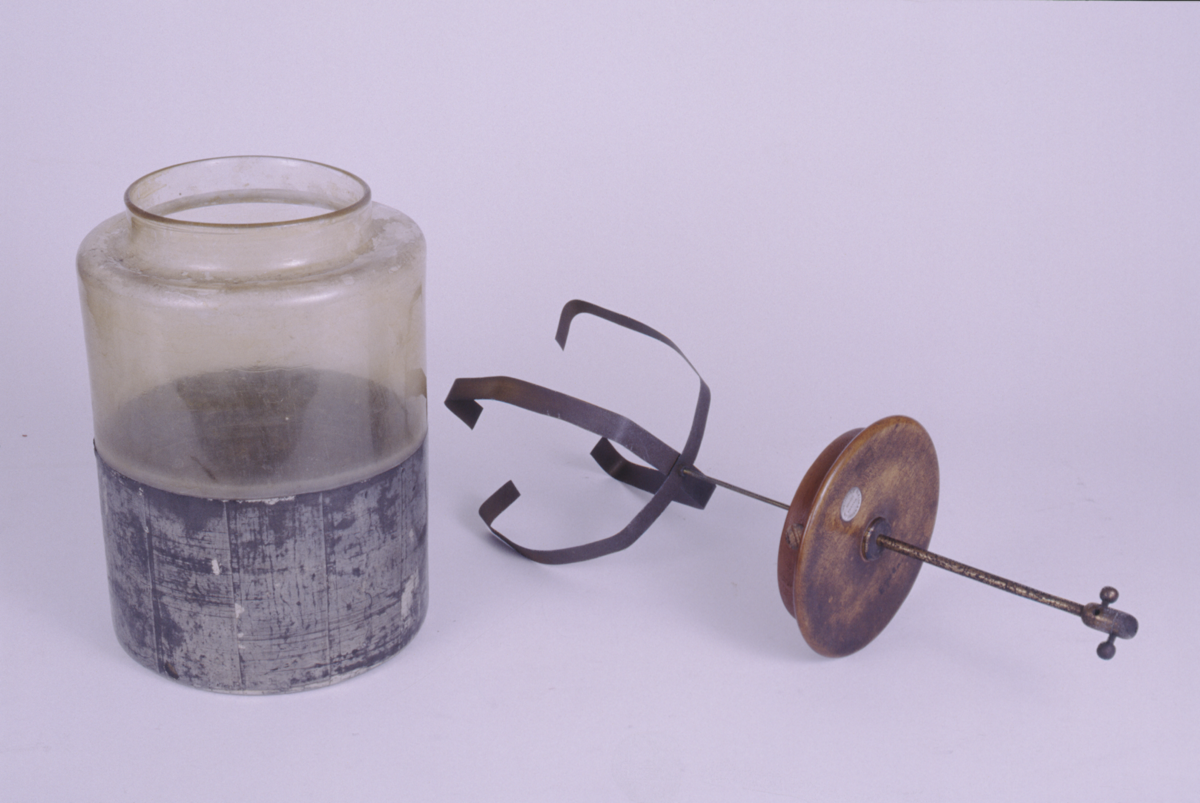
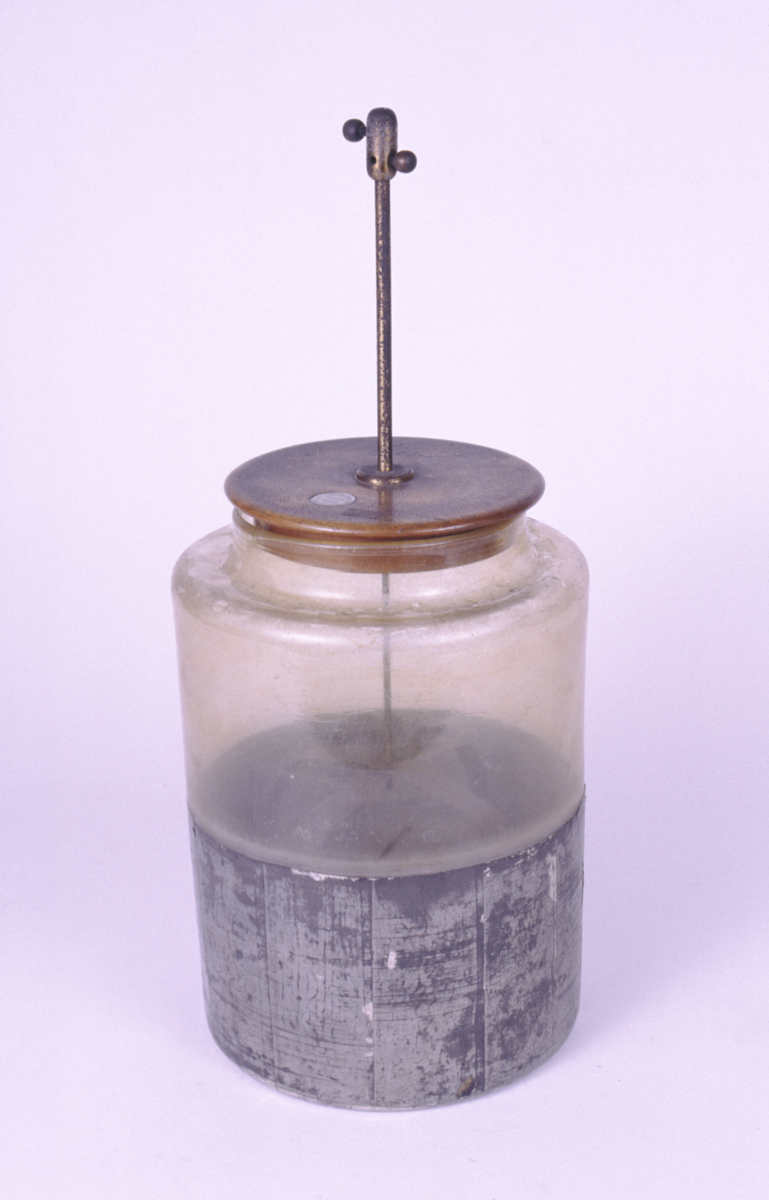
Leyden jar, by Newton and Wright Ltd., English, 1913
Origin
England; London; 72 Wigmore St
Maker
Newton and Wright Ltd.
Class
electrical
Earliest Date
1913
Latest Date
1913
Inscription Date
Material
glass; wood; mahogany; metal foil; metal; brass; cork
Dimensions
height 430mm; diameter 180mm
Special Collection
Cavendish collection
Provenance
Transferred from Cavendish Laboratory, University of Cambridge, 1974.
Inscription
‘NEWTON & WRIGHT, Ltd.
72, Wigmore St.
MAKERS
LONDON.’ (ivorine label on lid)
Description Notes
Glass jar with metal foil coating around lower half inside and outside. Turned mahogany lid with ivorine makers’ plate and three glued pieces of cork for friction fit. Beneath lid four spring metal contacts link inner foil to central brass stem; above a vertical brass rod is surmounted by a brass terminal with two holes and screw clamps.
Complete
References
Events
Description
Leyden jars are used to store electric charge and were a very early form of capacitor (a device used to store electric charge in electronic equipment such as a television or computer). The device was named “bouteille de Leyden”. This was after the first experiments that were carried out by Peter Musschenbroek and Andreas Cunaeus in Leyden, Holland in the 1740’s.
The discovery of the leyden jar was very important in the development of electrical theory in the second half of the 18th century. It became possible to study more powerful electrical charges and develop new concepts such as the electrical circuit, the area of surface electrified and the amount of charge. Before the invention of the leyden jar the electric charges that were produced could not be contained anywhere for long enough to be used or studied.
To use the leyden jar, it would have been first charged by an electrostatic machine such as a Wimshurst machine. The electric charge flows down the metal chain or rod to a metal coating inside the jar, consisting of lead or tin foil. Because of the glass material of the jar the electricity cannot leak out and so builds up inside the jar. To discharge the jar a curved rod was used which would have been held near the metal ball on the lid and the outer foil of the jar which causes a spark to occur.
FM:40559
Images (Click to view full size):