Accession No
4349
Brief Description
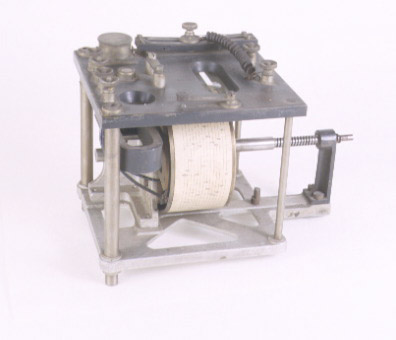
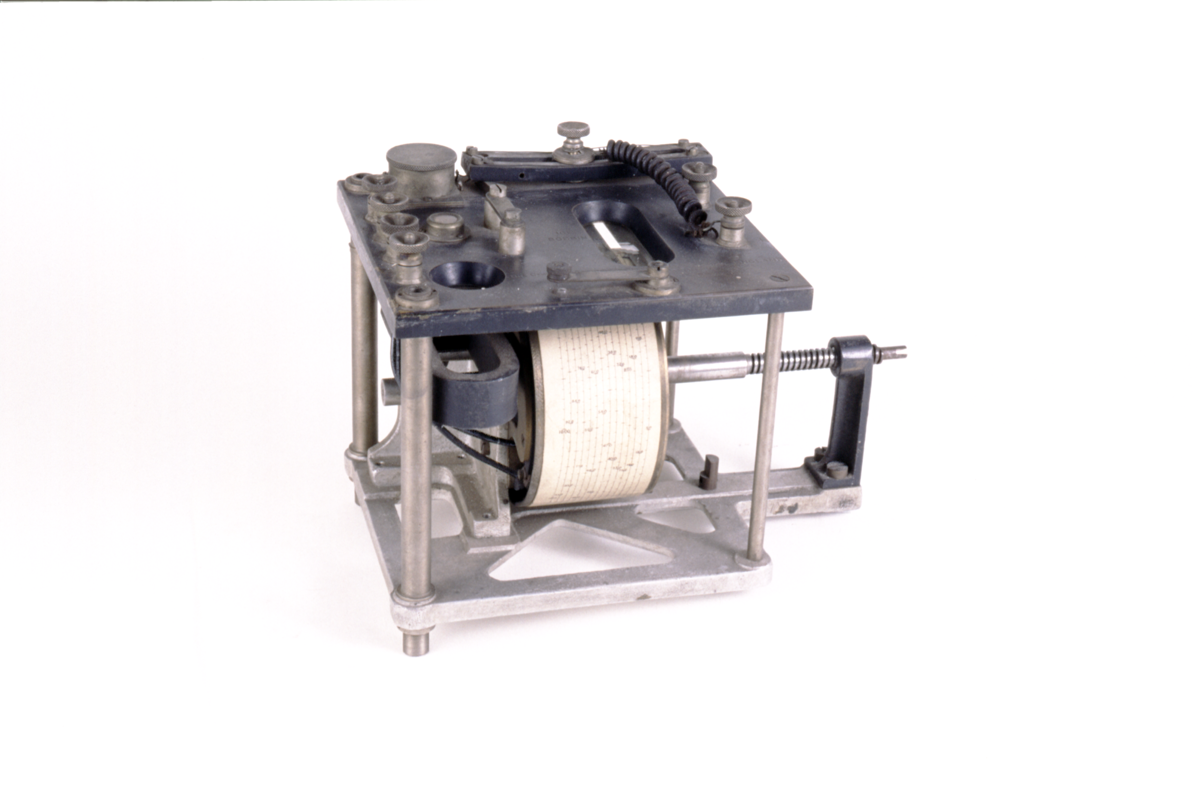
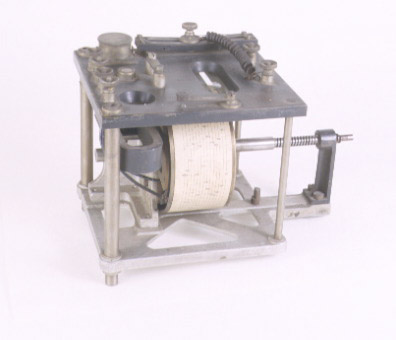
Whipple Temperature Indicator, self-contained Wheatstone Bridge, with direct-reading temperature scale, by Cambridge Scientific Instrument Company Ltd., English, 1909
Origin
England; Cambridge
Maker
Cambridge Scientific Instrument Company Ltd.
Class
physics; thermometry
Earliest Date
1909
Latest Date
1909
Inscription Date
Material
metal (steel, iron, brass); cloth; plastic (ebonite); paper; glass
Dimensions
height 200mm; length 280mm; breadth 173mm
Special Collection
Cambridge Instrument Company Collection
Provenance
Donated by the Cambridge Instrument Company.
Inscription
‘The Cambridge Scientific Instrument Co Ltd Cambridge ENGLAND
Whipple’s Patent Temperature Indicator UK 918 1902
No 8932’ (top)
Description Notes
Whipple temperature indicator; self-contained Wheatstone Bridge, with direct-reading temperature scale, Whipple Indicator type; made by Camb. Sci. Inst. Co., 1909;
Iron base with four steel pillars supporting an ebonite facia with six brass terminals. Rheostat. Within the main body of the instrument is a brass drum lined with ebonite with spiral paper scale for temperature. This is visible through a glass window in the upper plate; scale in Fahrenheit. Arrows indicating ‘Rise’ and ‘Fall’ in temperature. Bubble level.
Condition: poor (galvanometer broken); incomplete (handle missing and case?)
References
Events
Description
This instrument shows direct readings from an attached resistance thermometer. The Indicator can be a considerable distance from the thermometer without affecting the accuracy of the readings, which meant it could be installed in a convenient location, saving time and and reducing the need to disturb the conditions being measured. Robert Stewart Whipple designed the Indicator for Cambridge Scientific Instrument Company in 1902 as an improvement on the Callendar Recorder.
Robert S. Whipple (1871-1953), whose father George was the Superintendent of Kew Observatory, joined Cambridge Scientific Instrument Company in 1898 as personal assistant to the Company’s co-founder, Horace Darwin. Whipple had previously worked as an assistant at Kew, and assistant manager for L. P. Casella. He became Managing Director of CSIC in 1905, and served as Chairman from 1935 until 1950, remaining a Director until his death. In 1944, Whipple donated his private collection of historic scientific instruments to the University of Cambridge, founding the Whipple Museum.
31/03/2020
Created by: Morgan Bell on 31/03/2020
FM:40571
Images (Click to view full size):