Accession No
0820
Brief Description
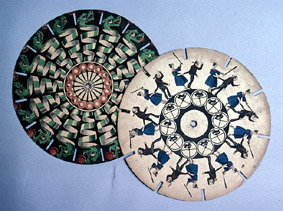
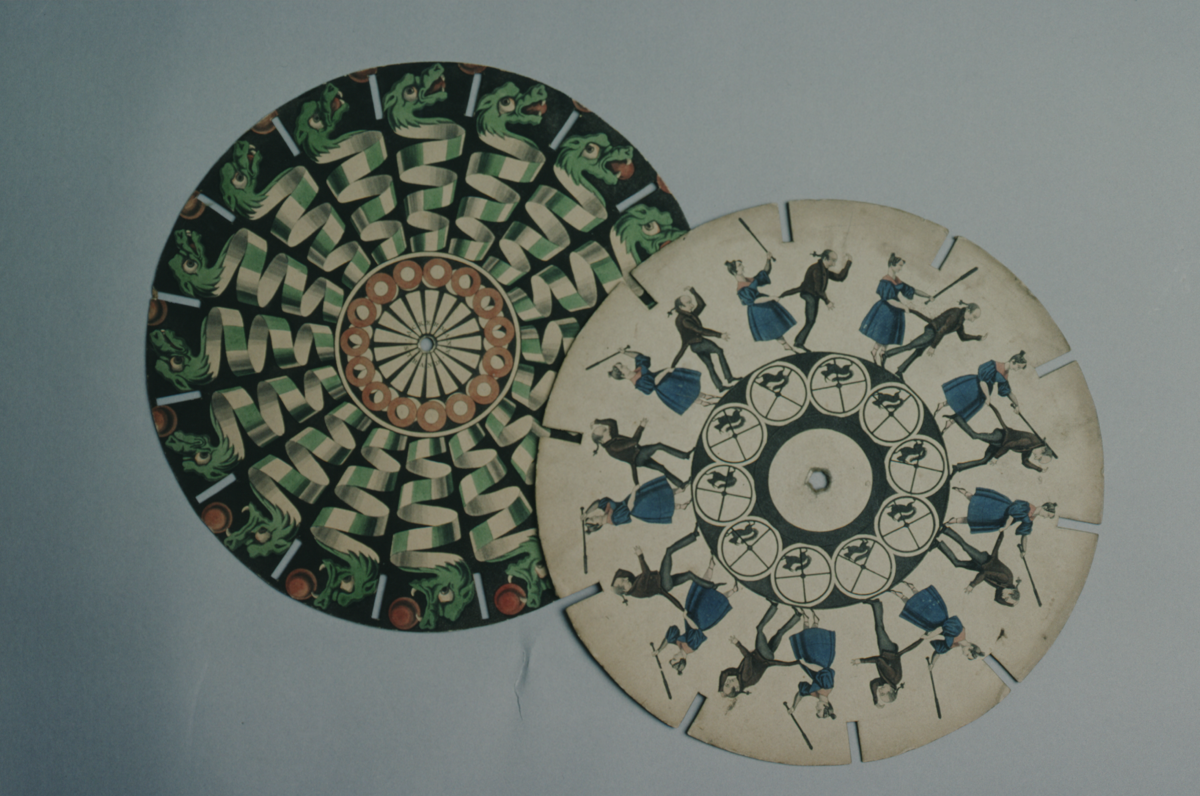
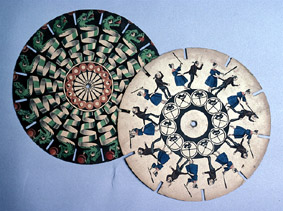
set of six phenakistiscope (aka stroboscope) discs, by S. W. Fores and Ackermann, English, mid-19th Century
Origin
England; London
Maker
Fores, S. W. Ackermann
Class
optical
Earliest Date
1833
Latest Date
1833
Inscription Date
Material
card
Dimensions
diameter 242mm
Special Collection
Robert Whipple collection
Provenance
Purchased from H.M. Fletcher, Enfield, Middlesex, England on 18/02/1937. Originally 7 discs.
Inscription
‘Pubd 1833 by. S.W. Fores 41. Picadilly.’ (on rim of one disk)
‘ACKERMANN. STRAND.’ (centre of one disk)
Description Notes
Set of 6 phenakistiscope (aka stroboscope; aka phenakistoscope) discs, by S. W. Fores and by Ackermann, English, mid C19th
Card disks with slots around circumference. Designs: man on bicycle, couple dancing, wife beating husband, pattern of dragons, man swallowing ball with magpie, and Indian juggler. Reverse of face swallowing ball carries:
“ FORES’S
OPTICAL ILLUSIONS,
PUBLISHED AT
41, PICCADILLY.
Screw on one subject at a time, - hold it before a Looking
Glass, looking through the small holes,-the distance
regulated by the eye. Turn round the subjects
some one way and some the other. Care should
be taken to have a good light upon the subject. They show
well by candle light.
Fores has just invented a Machine, by which two persons may view
at once two subjects, and without a glass
The Public are respectfully cautioned against some greatly inferior Subjects,
with a similar Title.”
Condition good
References
Events
Description
In November 1944, R.S. Whipple’s donation to the University of Cambridge was put on show in the East Rooms of the Old Schools. The University accepted the donation on the condition that they found a new institution within which to house the collection.
Whipple himself wrote a guidebook to this exhibition, describing some of the more important objects and books on show. The front cover includes the following declaration: “The Exhibits are drawn from the Collection which Mr R.S. Whipple is presenting to the University and will form a nucleus for a History of Science Museum and Library in Cambridge.”
Whipple's own explanatory text for these disks was:
" 'Wheel of life'
Two disks 12 in. diam., marked 'Fores's Optical Illusions'"
17/10/2025
Created by: Hannah Price on 17/10/2025
Description
Stroboscopic viewers were the first step towards cinema. It was the first time you could see moving pictures.
The stroboscopic viewer consisted of a circular disc which had a few dozen short lines cut out, these lines pointed into the centre of the circle and were equally spaced out around the circumference of the circle. On one side of the piece of circular card you would have a few dozen pictures, one picture for each slit in the card. These pictures would be slightly different from each other.
To use the stroboscopic viewer you would close one eye and then place the other next to one of the slits, making sure that the pictures were on the other side. Then you would hold a mirror up so that you could see one of the pictures on the other side of the card. Finally you would spin the circular card. The effect would be that you would see the object moving. Using these viewers you could make it so that you could see jugglers, juggling. In one of the viewers in the draw, it shows a wife beating her husband with a stick.
These stroboscopic viewers showed everyone that by flashing images that only differed slightly, you could fool a person into seeing a moving object.
Created by: Richard
FM:40601
Images (Click to view full size):