Accession No
3442
Brief Description
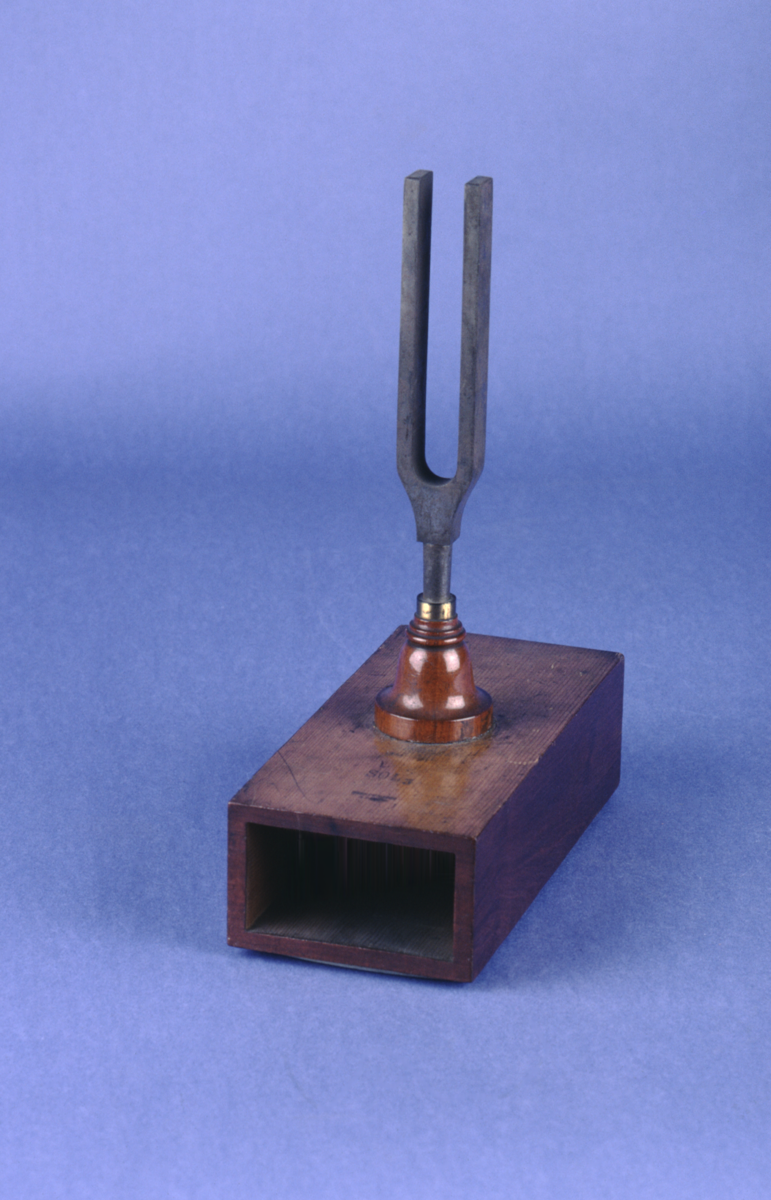
tuning fork on a wooden resonator box, by Rudolph Koenig, French, 19th Century
Origin
France; Paris
Maker
Koenig, Rudolph
Class
sound
Earliest Date
1800
Latest Date
1900
Inscription Date
Material
wood; metal; brass; rubber
Dimensions
height 273mm; length 199mm; breadth 98mm
Special Collection
Provenance
Purchased from King’s College, London, England, 10/1986. Purchased with the assistance of a grant from PRISM Fund.
Inscription
‘SOL3
RUDOLPH KOENIG
A PARIS’ (base)
‘SOL3
768VS
RK’ (tuning fork)
Description Notes
Tuning fork on a wooden resonator box, by Rudolph Koenig, 19th century.
Tuning fork set in turned wooden mount on a hollow wooden box with one open end. For Sol 3, i.e. the G above middle C.
Complete.
References
Events
Description
Tuning forks are used in the production of ‘pure musical tones’. They are made of two connected rods, or tines, which vibrate if struck by a rubber hammer or mallet. As the tines vibrate back and forth, they disturb surrounding air molecules. These disturbances are passed on to adjacent air molecules, creating sound waves. The rate, or frequency, of such waves depends on the length of the fork. This is referred to as its natural frequency, which determines the pitch of the note. When struck, this fork sounds a Sol 3, i.e. the G above middle C. Pure tones involve sound waves in which the air pressure rises and falls at a constant rate. Therefore, the tines of the tuning fork must also vibrate at a constant rate. Mathematically, pure tones are represented as a sine wave, which is the simplest type of periodic vibration.
This instrument was designed and constructed by Rudolph Koenig (1832-1901), a German physicist who was primarily concerned with acoustic phenomena. Inspired by the new research of Herman von Helmholtz (1821-1894) and the growing "science of musical sounds”, Koenig started his own scientific instrument business in Paris in 1858. He quickly gained an international reputation for the quality and precision of his instruments. Although the tuning fork had been invented in 1714 by John Shore in order to tune musical instruments, Koenig transformed it into a scientific instrument. It had a significant impact on the scientific community and was used in many consequent experiments relating to measurements of sound, light and time-relations. The relative thickness of Koenig’s tuning forks compared to others is attributed to his attempt to reduce unwanted harmonics, and purify the tone.
This tuning fork is mounted on a hollow wooden box with one open end, which is used to amplify the sound to an audible level. As the tines move back and forth, the stem of the fork moves up and down setting the sound box into a vibrational motion. In turn, the sound box causes the air inside it to vibrate at the same frequency. Given the larger surface area of the box compared with the tines alone, more particles of air can be made to vibrate and consequently a louder sound is produced.
14/04/2008
Created by: Jonah Lipton on 14/04/2008
FM:40603
Images (Click to view full size):