Accession No
4617
Brief Description
mechanical calculator, Curta Type II, by Contina Ltd., Liechtenstein, 1954
Origin
Liechtenstein; Mauren
Maker
Contina Ltd.
Class
calculating
Earliest Date
1954
Latest Date
1954
Inscription Date
1954
Material
metal (white metal and one other); plastic (bakelite); enamel; paper (card; corrugated card and two others)
Dimensions
height 130mm; diameter 60mm
Special Collection
Provenance
Donated on 07/11/1996.
Inscription
‘System Curt Herzstark
Made in Liechtenstein
by Contina Ltd Mauren
No 503772’
Description Notes
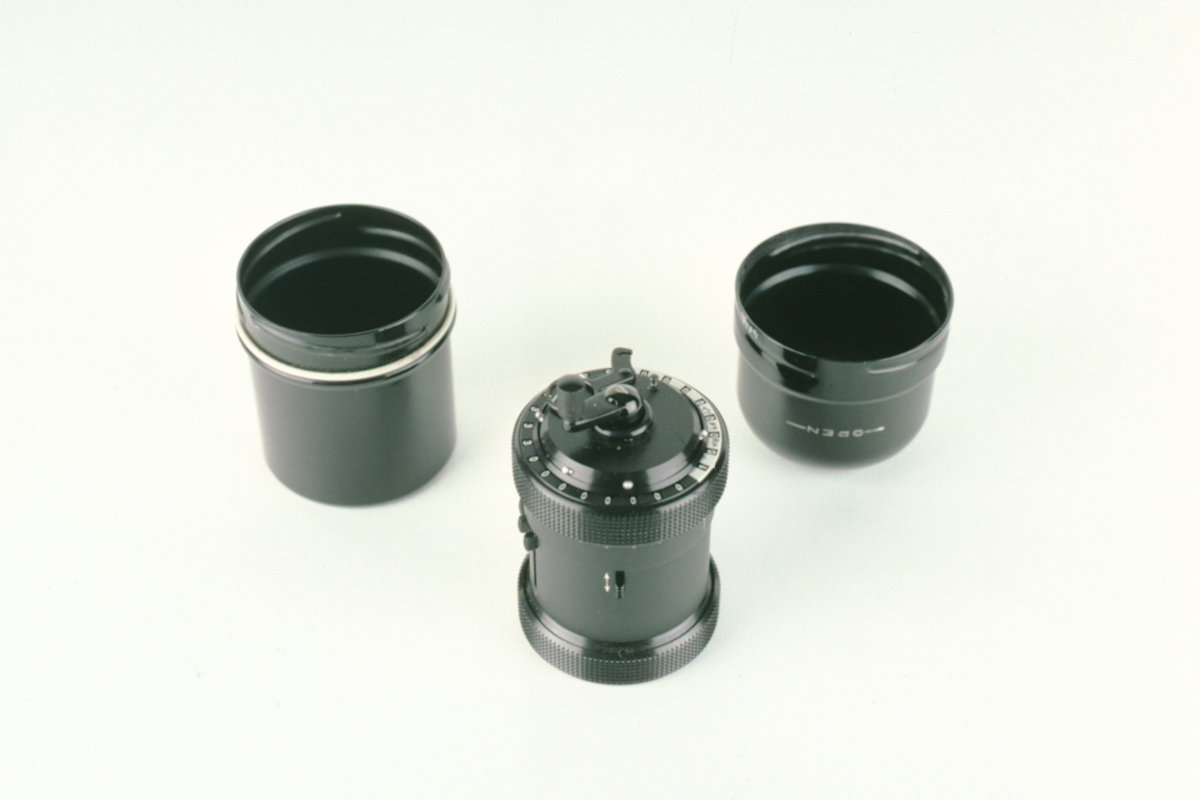
Black-painted metal cylinder with plastic ends. Crank handle emerging from top. 11 input and 15 output digits. Small metal sliding knobs along the input and output scales for setting decimal points and groupings.
Original enamelled metal screw-top storage case.
Calculator in working order.
Instructions leaflet for the Curta Model 1 in fair condition.
Guarantee certificate for machine no. 503772 dated 25.11.1954, in fair condition.
Original card box with stick-on Label marked 503772 and longhand inscription “Dr Heynell”. Fair to poor condition, lid detached.
General condition good; complete
References
Events
Description
The Curta calculator is one of the smallest mechanical calculating machines ever made: in fact, a pocket calculator. It was developed by Curt Herzstark, an Austrian who worked on the plans whilst in a Nazi concentration camp during the Second World War. His captors encouraged him with the aim of presenting the device to Hitler to celebrate victory in the war. In 1945 Americans liberated the camp and Hertzstark moved to Liechtenstein to manufacture his product. By 1973 they were discontinued due to the success of the electronic pocket calculator, having sold around 140,000 machines.
Curt acheived this four function calculator by inventing the complemented stepped drum to perform calculations. Previously, all mechanical calculators manufactured in large numbers had been based on either a stepped drum (traced back to Leibniz) or a pinwheel (introduced by Odhner). The term ‘complemented’ refers to the fact that it uses an algorithm to turn subtractions into additions, and a ‘stepped drum’ is a cylindrical driving element with protruding ribs of various lengths.
Here is an example calculation:
133x89 = ?
- reset the counters (by lifting the carriage and turning the clear handle) and set the carriage in position 1
- set the number 133 using the setting knobs
- pull up the crank so that it is in subtractive mode and make one revolution, which calculates 133x(-1)
- set carriage in position 2 and, with the crank still pulled up, make a subtractive revolution, which calculates 133x(-10)
- set carriage in position 3, push crank back in the position for addition and make one revolution, which calculates 133x100.
A check is provided by the revolution counter, which shows 89, so we did multiply 133 with 89. The result 11837 can be read in the result counter. What has been calculated is 133x(-11+100) and that is equal to 133x89; this was done in 3 revolutions instead of 17.
29/08/2007
Created by: S Davis on 29/08/2007
FM:40610
Images (Click to view full size):