Accession No
4473
Brief Description
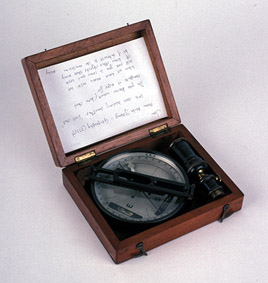
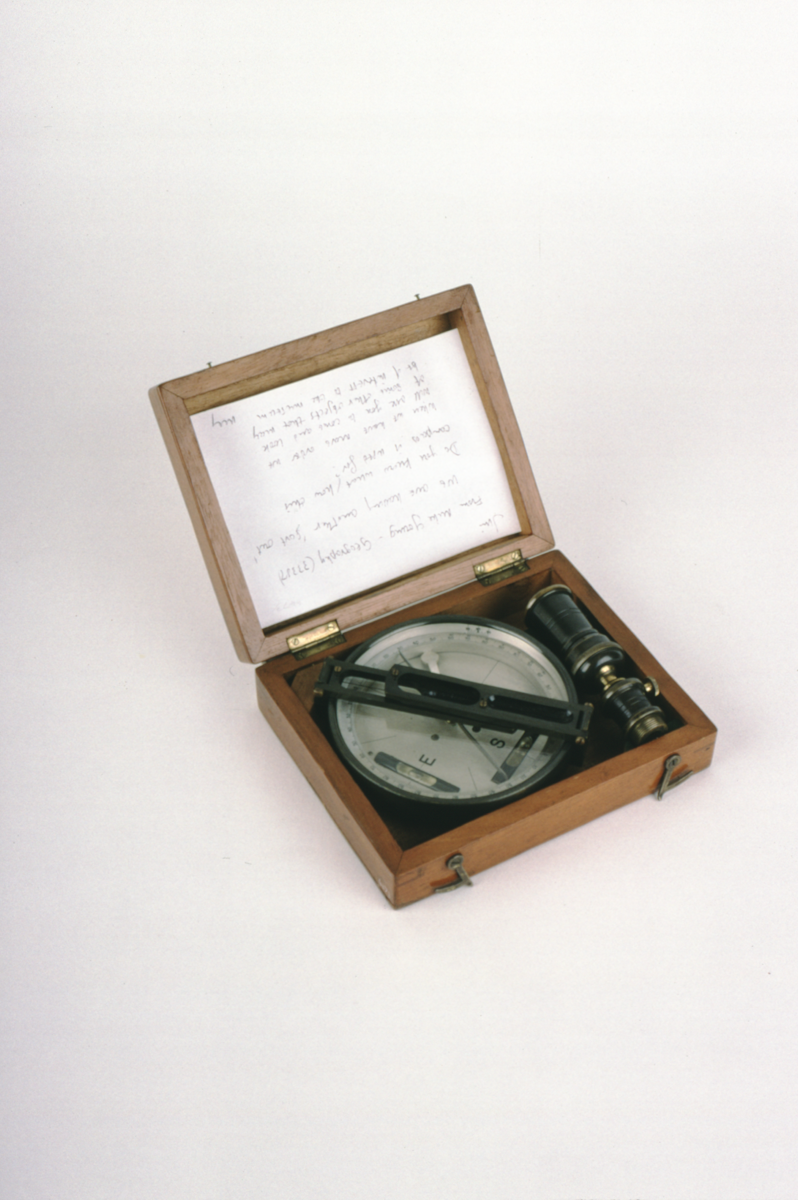
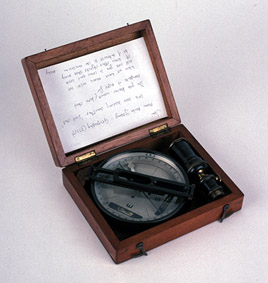
surveying compass, by E. R. Watts and Son, English, mid-20th Century
Origin
England; London
Maker
E. R. Watts and Son
Class
surveying
Earliest Date
1900
Latest Date
1948
Inscription Date
Material
metal (brass, oxidized brass, white metal, steel); glass; wood; cloth (felt)
Dimensions
overall height 200mm; diameter 112mm box length 169mm; breadth 133mm; height 47mm
Special Collection
Provenance
Transferred from the Department of Geography, University of Cambridge, on 18/03/1994.
Inscription
‘E.R. Watts & Son.
London. Eng.
Ottawa & Winnipeg.’ (on one of the sights)
Description Notes
surveying compass, by E.R. Watts, mid C20th, with detachable tripod mount. Main instrument has compass with raised degree scale divided 0 - 90˚ - 0 - 90˚ - 0 numbered by 10˚ graduated to 1˚. Also a Vernier scale and magnetic variation scale around the west point. Cardinal points marked by initials. Two orthogonal bubble levels. Steel needle with locking bar. Outer ring of compass carries two slit and thread sights and can be rotated to adjust the compass for magnetic variation. Screw-fit tripod connector with alt-azimuth mount. Fitted wooden box with felt lining.
Card with note detailing donation was inside lid of box - now moved to OHF (21/10/2014).
Condition good; complete
References
Events
Description
The circumferentor is an instrument that derives from the reverse side of an astrolabe. It is used to measure horizontal angles, or vertical angles by suspending the instrument from its shackle.
The circumferentor was described by Arthur Hopton in 1611, though passing references had been made to it in earlier works. It became one of the standard pieces of equipment of the surveyor throughout the 17th and 18th centuries.
From display label:
Magnetic compass fitted with sights so as to take bearings with reference to the magnetic meridian. This instrument is also known of as a ‘circumferentor’. The circular scale on this instrument is divided at intervals of 1 degree of arc, giving 360 divisions.
31/08/2006
Created by: updated by Ruth Horry on 31/08/2006
FM:40673
Images (Click to view full size):