Accession No
4330
Brief Description
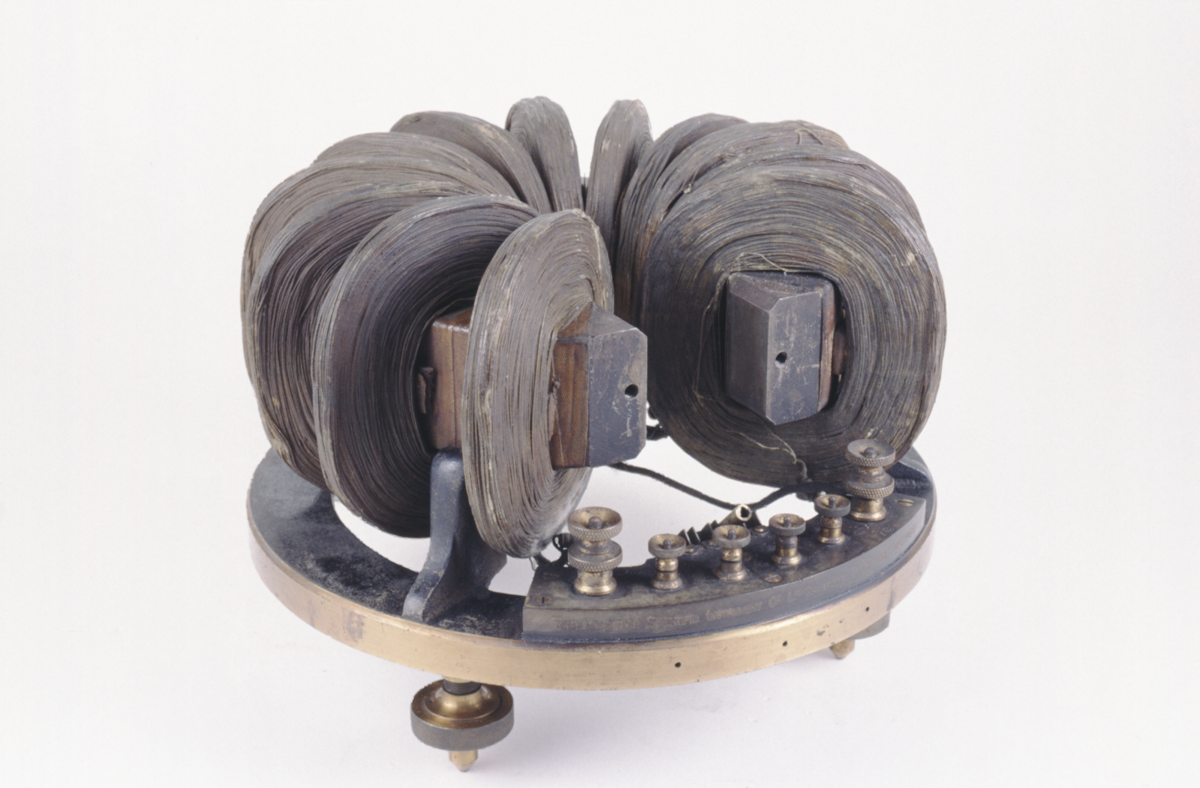
double, low frequency oscillograph, Duddell type II (early model), by Cambridge Scientific Instrument Company Ltd., English, c. 1905
Origin
England; Cambridge
Maker
Cambridge Scientific Instrument Company Ltd.
Class
electrical
Earliest Date
1905
Latest Date
1905
Inscription Date
Material
metal (brass, iron, copper); plastic (ebonite); cloth
Dimensions
diameter 271mm; height 211mm
Special Collection
Cambridge Instrument Company Collection
Provenance
Donated by the Cambridge Instrument Company.
Inscription
‘The Cambridge Sciebntific Instrument C0 Ltd ENGLAND NO 3969’ (ebonite plate)
Description Notes
Double, low frequency oscillograph, Duddell type II (early model), by Cambridge Scientific Instrument Co., English, c. 1905.
Circular cast brass base. 4 pairs of brass terminals, 2 pairs to electromagnetic coils and 2 pairs to vibrating elements. Circular electromagnets with 12 coils.
Condition fair (coils loose); incomplete (vibrating system, standard and fuses missing)
References
Events
Description
The Duddell oscillograph was patented in London in 1898 and was used in various forms until the 1960s. It was developed into a highly successful commercial instrument through a partnership between its inventor, William Du Bois Duddell, and the Cambridge and Scientific Instrument Company. The oscillograph was the first scientific instrument capable of producing a complete, real-time image of alternating current electrical waveforms. It is comprised of a rotating or vibrating mirror fixed on a single electric coil held under tension between the poles of an electromagnet. Variations in current induce momentum in the coil, creating minute movements in the mirror, which can be observed and traced through the reflection of a beam of light. This can display an instantly visible trace, or photographic accessories can be used to produce a permanent record. The automatic nature of the oscillograph saved both time and labour in the measurement, analysis, and comparison of varying electric currents. This model is an early model of the Duddell type III.
William du Bois Duddell (1872–1917) studied at the new technical colleges developing in London and around the country, which provided the first academic arena for electrical engineering in Britain. Duddell studied under William Edward Ayrton (1847–1908), who taught at Finsbury College and the London Central Technical College as Professor of Applied Physics and spent most of his career defining and legitimating an academic forum for electrical engineering in Britain. These technical colleges were self-consciously different than traditional physics laboratories, combined industrial workshop and field sites with formal training. Duddell’s training in these London institutions strongly influenced his own subsequent work, including his design for the oscillograph, a practical, portable, highly accurate instrument. The first detailed explanation of Duddell’s design appeared in The Electrician in 1897, and within a year the Cambridge Scientific Instrument Company was producing the first commercially-available versions of the instrument. CSIC continued to produce improved versions of Duddell’s design into the 1950s, when it was finally superseded by the oscilloscope.
08/01/2015
Created by: Joshua Nall on 08/01/2015
FM:40991
Images (Click to view full size):